Showing posts with label meat. Show all posts

February 17, 2010

Retronovated Recipes: Braised Turtle

I've been doing some research on turtle meat for my upcoming Edible Queens article and I wanted to share a great recipe that won't make it to print.  The reason?  The article is due out in June, and this slow braised, spicy dish is perfect for winter.  The taste of the tender meat will envelop you like a warm hug.

My inspiration was the first printed American recipe for turtle from Amelia Simmon's American Cookery.   I actually used veal to test this recipe, and I think it would be equally good with a cut of beef or lamb.  This dish is so easy and delicious, you should serve up some turtle meat surprise at your next Sunday dinner.

***
Braised Turtle
Inspired by "How to Dress a Turtle," from American Cookery by Amelia Simmons, 1796

1 lb fresh or frozen turtle, beef, or lamb.
2 c. beef stock
½ tsp salt
½ tsp black pepper
¼ tsp cayenne pepper
¼ tsp nutmeg
¼ tsp mace
½ tsp each dried thyme, marjoram, parsley and savory; mixed.
½ cup Madeira wine or sherry

1. Preheat oven to 400 degrees.

2. Rinse meat and pat dry; cut into one inch cubes.  In a bowl, toss turtle meat with salt, pepper, cayenne pepper, nutmeg and mace.

3. Add meat to a baking dish or dutch oven.  Sprinkle with herb mixture.  Pour in Madeira or sherry and beef stock. Cover, and bake for two hours.

January 25, 2010

History Dish Mondays: Bazmaawurd, Mulahwajah and Juudhaab


Bazmaawurd ready to be rolled.

A few weeks ago, I mentioned the article Cooking with the Caliphs, which analyzed a medieval cookbook from the court of 10th century Baghdad:

"A little over a thousand years ago, an Arab scribe wrote a book he titled Kitab al-Tabikh (The Book of Recipes)... The book has come down to our time in three manuscripts and fragments of a fourth—and what a treasure it is. These are the dishes actually eaten by the connoisseurs of Baghdad when it was the richest city in the world."

Yesterday, I had a few friends over, and we tried some of these 1,000 year old dishes.

To begin, I presented Bazmaawurd: chicken, walnuts, fresh herbs and lemon (it was supposed to be citron, but I couldn't find one fresh) rolled up in a Lavash.  I think this was everyone's favorite.  The flavors were so fresh, light and zesty.  I found it to be a little dry--but it went nicely with some labneh.

Next I dished up a seasoned lamb dish called Mulahwajah, of which I neglected to take any photos (tipsy).  I stewed lamb meat with leeks, onions, a cup of water, and a fascinating spice blend:  coriander, cinnamon, caraway, pepper, and galangal.  The latter is a spice with a light, flowery, almost citrus taste.  And this recipe calls for a lot of spice: 5 1/2 teaspoons for a 1/4 pound of meat.  It covered the meat completely, but lamb has such a pungent flavor it stands up well to heavy spicing.  The result was a dish that blurred the boundary between sweet and savory with flavor unfamiliar to western tongues.

Lastly, I made Juudhaab: "The supreme roast meat dish was juudhaab (or juudhaabah), where the meat was served on a sweet pudding which had been baked at the bottom of the tannur to catch its dripping juices."   This dish is vaguely similar to Yorkshire Pudding, in that a soft bread is cooked using fat from the meat it is served with.  But the resemblance is remote; in fact, I have never heard of a food prepared quite this way before.


***
Juudhaab
From Kitab al-Tabikh by Abu Muhammad al-Muzaffar ibn Sayyar, approx. 945 AD
Translated by Linda Dalai Sawaya for Cooking with the Caliphs.


1 whole chicken
¼ cup plus 2 tablespoons rosewater
ground saffron
1 pound dried apricots
2 fresh lavashes, pitas or other flatbreads, 12" in diameter (or more, if smaller)
½ cup brown sugar

1. Preheat oven to 500 degrees. Place apricots in small saucepan, add water to cover apricots by ½ inch. Bring to a boil and stew until apricots are soft and the water has reduced to a thin syrup, about 15-20 minutes.

2. In a baking pan or bottom of a broiling pan, place one lavash.  Strew with apricots in syrup, sugar and 1/4 cup rosewater in which pinch of saffron has been dissolved, then cover with remaining lavash.  Cover with a wire rack or top of the broiling pan.

3.  Wash chicken and pat dry. Mix 2 tablespoons rosewater with pinch of saffron and rub on chicken, inside and out. Place on rack or on broiling pan.

4. Bake at 500 degrees for 20 minutes, then turn heat down to 325.  Roast until a thermometer inserted into the thickest part of the thigh reads 160-165.

5.  Carve chicken and serve in slices over the lavash and apricot pudding.

***

The result was interesting: I wasn't thrilled with the slightly greasy taste and texture of the sweet pudding.  But my guests tore into it with grunts and "mmm"s.  The lone vegetarian was mortified.  But we still love her.

Check out all of these recipes and more in the original article here.

January 21, 2010

In the News: Meat, Meat, MEAT


A pig's head made from newspaper, wire mesh, and clay.  Not your grade school craft project. (historicfauxfood.com)

Head's up! The Brooklyn Beefsteak is back February 20th.  Stay tuned into their blog for updates here, and read my write up of their fall event here.

The New Age Cavemen and the City:  A group of New Yorkers swear by the Paleo Diet, which involves eating and exercising like a caveman. (nytimes)

Historic Faux Foods: "Sandy Levins researches the foodways of bygone eras to create historically-accurate individual faux foods as well as entire period table and room settings. " Rendered in astounding accuracy--check out her website.

October 30, 2009

On a Personal Note: Showered with Gifts!

I treasure my new nutmeg grater.

On Wednesday, I braved the rain and the wind to go to Whisk, a delightful kitchen supply store in Brooklyn. I won a $25 gift certificate earlier this month, so I arrived with a list of small items I needed for my kitchen.

It warmed my heart to be able to pick out some tiny treasures. I got: A beautiful roll of brown parchment paper, which I think I may use to wrap my Christmas presents; a cookie cutter in the shape of an oak leaf and a jar of silver sanding sugar (also for Christmas presents); a candy thermometer, a tea ball, and (best of all) a nutmeg grater. I have wanted a nutmeg grater for years, and the one I got at Whisk is truly special. This nutmeg grater is the same make that I used in my other life in 1848. Hanging on a rack of completely modern and ordinary kitchen utensils, its punched-tin design seemed terribly out of place. I snatched it up and cradled it; I love it so.

When I returned home, a package had come for me in mail. A reader of this blog had mailed me some cookbooks: a two-volume set of 15th Century recipes called Take a Thousand Eggs or More by Cindy Renfrow. This reader had bought them several years ago at a renaissance festival, and never got around to using them. She decided they needed a new home.

I haven't done much work with Medieval or Renaissance cookery, but upon scanning the index, the heading "Spectacle Foods" caught my eye. The first entry: "Appraylere: a false pitcher made of pork, cheese and bread." What??? Meat Pitcher? Awwwwwesome!

Box of meat! Sarah Lohman, your ship has come in.

Lastly, yesterday morning the Fed-Ex truck arrive with a box of free meat. How this free meat came to be is a long story, but it's from D'Artagnan, a local purveyor of elegant products. I got two tiny chickens, heritage breed bacon, buffalo steaks, duck foie gras, and two types of truffle butter. I've never even owned a truffle before!

I feel truly fortunate to have received all of these wonderful gifts; they are going to take me on some wonderful food adventures
.

August 28, 2009

The Great Alaskan Meat-Off

I just came back from a two week trip to Alaska, where I staid with my friends Chris and Kristina in Girdwood, a suburb of Anchorage. I wanted to share with you some of the food I consumed.

Because of my continuing obsession with sourdough bread, Kristina took me to the local bakery, The Bake Shop. As we arrived, so did a busload of tourists: The Shop seems to be the go-to breakfast stop for locals and tourists alike. I purchased a loaf of sourdough bread, which was surprisingly mild and delicious. Sourdough is associated with gold mining regions, like Alaska and San Francisco, because the miners could make it without taking a "sponge," or yeast culture, with them. It could be created from yeast spores in the air.

Kristina gifted me with a bag of locally-made sourdough starter, which gets going after you add a can of beer. I'm excited to try it, but I still want to try to create a starter from air-borne yeast.

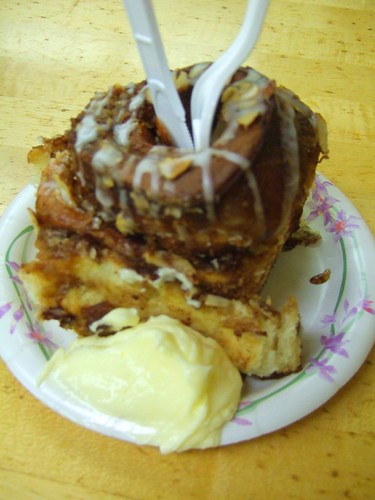
I also had "Sweet Roll with a Side of Butter," also made of sourdough, and also delicious. It had cinnamon and almonds, but also mysterious notes of brandy and anise. I had two over the extent of my stay.


Kristina, who was a vegetarian when I knew her in college, took me on a shopping trip to Indian Valley Meats. Another local vendor, they specialize in breaking down and preparing carcasses for local hunters, and sell a variety of locally raised game meats. Kristina selected and prepared a menagerie of local animals for me to ingest:

Clockwise, from left to right: Moose, Buffalo, Caribou, Elk, and Reindeer. Caribou and Reindeer are actually the same thing, the latter being wild and the former being farmed.

I also ate wild boar jerky, which was covered in some sort of garlic glaze I wasn't too keen on, and salmon that Chris had pulled from the river days earlier. This fish was delicious--and I hate fish.

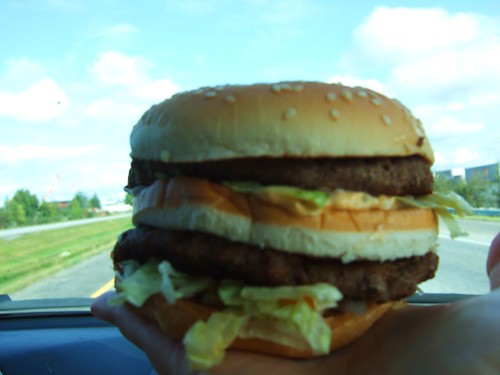
In my second week, while on our way to Denali National Park, I finally acquired the object of my true desire: The Mc Kinley Mac. I had seen a poster for it as soon as I stepped off the plane, and had fantasized about it since. The Number 12 on the menu, this double-stacked McKinley Mac is only available in this state. Which is ok, because as I excited as I was to sample it, it just turned out to be a big gross burger.

The McKinley Mac and I zoom towards Mt. McKinley, on our way to Denali national Park.

On the way back from Denali, we stopped at a Burger King in Wasilla. The BK menu included a Sourdough Whopper, but after a week in the wild, I wasn't in the mood to take a risk.

Lastly, I made up a batch of Spruce Tea, after harvesting a few limbs from Alaska's State Tree. It did not just taste like pine needles, but had a richer, spiced flavour. The batch I brewed was fairly weak, and I wanted to make a proper pot of tea when I returned to New York, but I forgot my bag branches in Girdwood. Perhaps Kristina will be kind enough to ship a few stateside--I'm curious to pass some along to my beer brewing friends, so they can make an authentic Spruce Beer.

At every restaurant we went to (three in the small town of Girdwood alone) the food was excellent, something I definitely didn't expect when coming to Alaska. Additionally, there were very few chain restaurants; the ones that were there hadn't even popped up until the last decade. Alaska's relative isolation seems to have resulted in a bevy of independently owned restaurants with excellent food.

If you're interested in my non-culinary Alaskan adventures, you should look at my photos here.


February 10, 2009

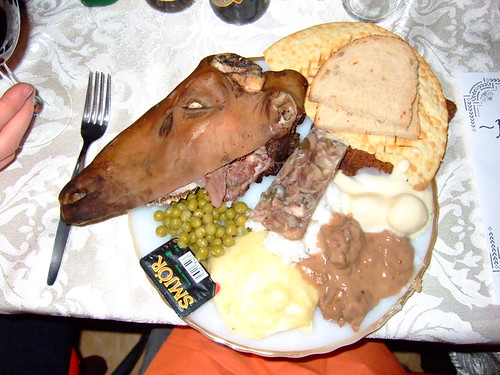
Eating Offal at Þorrablót


My buddies in Iceland are experiecing the festival of Porrablot, a feast of traditional and historic Iclelandic food. It features all kinds of cured meats and offal, many of which are at least partially putrified. The feast includes Hrútspungur (cured ram's testicles), and Hákarl (fermented shark). According to my sources, the shark tastes like cat pee.

To learn more, head over to Ameriskur.

January 9, 2009

Eating Like A Tenement Family: Day 5


Lamb and Turnips: A World of Beige


Breakfast: Toasted Bread and Scalded Milk

The usual.

Cost: .32 cents

Lunch: Mutton and Turnips

Mutton and Turnips is prepared according to the instructions for Salt Pot-au-Feu. I used a lamb shank ($2.47), and chopped up one turnip (.86) and half an onion (.05 cents). I rinsed the lamb and patted it dry, then rubbed it with salt and pepper. I heated a tablespoon of butter (.15 cents) with a dash of cooking oil in a pan, then browned the lamb all sides. I took out the lamb and tossed in the the onion (mmm..lamb fatty onions.) I browned them a little, then added the turnip and let it cook about a minute more. I put the lamb back in, and added water until the lamb was about 3/4 covered. I put a lid on the pot, and left it at a low boil for half an hour. After straining out the lamb and veggies, I saved the broth for supper and tomorrow's breakfast, as usual.

I declare the dish edible, but not delicious. The turnips were a little over done, but tasted strangely like broccoli cheese soup. The lamb was gummy--I'm beginning to think boiling is not the best method in which to prepare meat. The cut of meat I selected was also pretty fatty, which is probably why it was relatively cheap. However, lamb has a very rich flavour, and it maintained some of that. It was probably one of the most flavourful things I've eaten this week.

Cost: 3.52 (Yikes.)

The hardest part about this is not necessary the taste of the food; but after I'm done I still feel hungry, and all I have to look forward to is continuing to be hungry.

Supper: Barley Boiled in Stock

I reheated the lamb broth from lunch, and added a 1/2 cup of barley. I simmered it about 45 minutes. I have to say it was pretty damn good. The broth was very flavorful, and the barley absorbed it all, but left a starchy goo between the kernels. It was salty, warm and satisfying; but I still could only eat about half before I was full. I put the rest in the fridge for tomorrow.

Cost: .39 cents

I also had one extra cup of milk (.25 cents)

Total Cost: $4.48
Approximate Calories Consumed: 763

Running Total: $12.54- $13.08


I often feel overwhelmed and out of patience, especially after physical activity. I live about a mile from the subway, so after a walk to the train I'm a pretty cranky bitch.