Showing posts with label presidents. Show all posts

February 22, 2010

Menus: Washington's B-day at Niblo's Saloon, Broadway

Eaten on this day in 1851 at Niblo's Saloon.  I think my favorite dishes are the Chicken Sallad and the Beef Tongues, both served in "gelee"; the Pigeons and the Widgeons; and (no party is a party without) Charlotte Russe.  I don't know which would have been my favorite ornamental piece; probably the Fruits of Industry.

February 15, 2010

Cocktail Hour: A Toast to the Presidents!

Simon Ford of Liqour.com adovocates the celebration of President's Day with Classic Cocktails:
"Franklin Roosevelt guzzled Martinis, Richard Nixon drank Cuba Libres (you have to love the irony) and Gerald Ford enjoyed the odd Gin & Tonic. Woodrow Wilson, president during the enactment of Prohibition, stashed away supplies so that he could mix his favorite libations in secret while the rest of the nation settled for bathtub gin and moonshine.
I think it’s fair to say that the proper way to celebrate Presidents’ Day (and the long weekend) is with cocktails. Here are a couple of historic drinks to get you started. Cheers!"
Read the full article here, and mix up a few classic cocktails appropriate to the Presidents.

January 7, 2010

Origin of a Dish: Macaroni and Cheese


An American classic.

Macaroni and Cheese is largely thought of as a modern dish, thanks to the "Kraft Dinner," introduced in 1937 and used as rations during WWII.  But good 'ol Mac n' Cheese  has a much longer history.  In fact, I've already cooked up two different versions of this classic dish on this blog: a simple, 19th century version I ate during the Tenement Diet, and a more decadent recipe using neufchatel cheese during the Kellogg Diet.

Macaroni was possibly invented by the Romans, and was served with cheese sometime in the Medieval era (source).  The first documented occasion on which Macaroni and Cheese was served in America was at the White House in 1802, during Jefferson's presidency. A guest at one of Jefferson's dinner parties recounts his first experience with the dish (source):
"...A pie called macaroni, which appeared to be a rich crust filled with onions or shallots, which I took it to be, tasted very strong, and not very agreeable. Mr. Lewis told me there was none in it; it was an Italian dish, and what appeared like onions were made of flour and butter, with particularly strong liquor mixed in them."
The earliest known American recipe for macaroni and cheese appears in The Virginia Housewife, first published in 1824.  This is the recipe that we shall attempt today.


It seemed decadent to boil the macaroni in milk, but I gave it a whirl to stay true to the recipe.  While the pasta was cooking, it smelled sweet like a rice pudding; however, upon tasting it, I could discern no noticeable difference.  I think that this step could be left out, if you desire.

I used a Queso Blanco, an un-anged, simply made Mexican cheese.  I choose it for it's similarity to farmer's cheese, and other fresh cheeses used in the 19th c.


***
Macaroni and Cheese
from The Virginia Housewife: or, Methodical Cook By Mary Randolph, 1838 ed.

1/2 lb macaroni
1 quart whole milk
12 oz sliced farmer's cheese, queso blanco, or queso fresco
1 stick unsalted butter

1. Preheat oven to 350 degrees.  Bring one quart milk and an equal amount of water to a rolling boil.  Add macaroni and cook, uncovered, until al dente, about 6 1/2 minutes.

2. Drain in a colander. While still in the colander, sprinkle pasta with about a 1/2 tsp salt, shake to combine, then sprinkle with about 1/2 tsp more (or to taste).

3. Our about 1/3 of the pasta into a casserole or baking dish.  Cover with 1/3 of the cheese and butter.  Repeat, ending with a layer of cheese and butter on top.

4.  Bake uncovered for 25-30 minutes, or until cheese is melted and bubbly.

***

My roommate and I took two bites and then made frowny faces at each other.  I don't think this is the best incarnation of Mac and Cheese.  It tasted like buttery noodles.  And then...something was OFF with the cheese I bought.  It had an odd bitter/fishy taste. I don't know if was the brand of cheese, or if the cheese was bad.  But I would take Kraft over this any day.

October 29, 2009

The Gallery: Eating What the Presidents Ate

Left: Wine Jelly.
Recently, I've been reading The First Ladies Cookbook: Favorite Dishes of all the Presidents of the United States. It was printed sometime around 1976, in the history-loving fervor surrounding our bicentennial. I'm always a little suspicious of historic books printed in this era, as the research often seems a tad sketchy. But TFLC (as it shall hereby be known) seems fairly trustworthy, and has footnoted its references. I always appreciate a good footnote.

I learned a few interesting facts after glancing over the introduction, "Notes on Early American Cookery." It speaks of the early housewife, who regulated "...the temperature (of) the Dutch oven so that she would not have a 'sad cake...'" Meaning: a cake that was baked unevenly, so that it was tragically lopsided and irrevocable burnt. A sad cake! Aw.

I also discovered a thing or two about Gelatin: "Gelatin was made from calves' feet, or from a product called isinglass, taken from the swim bladders of fishes...In the elaborate molded desserts they gave a meaty or fishy flavor to the pudding." Jee-sus.

Additionally, I found out Thomas Jefferson was not only quite the gourmand, but also a consummate host. I've added this new knowledge to my list of reasons to love Jefferson--in fact, thinking of him makes my heart flutter.

Being a widower, Jefferson would occasionally call upon the aid Mrs. Dolley Madison, the wife of his secretary of state. She seems like she was a real firecracker--she saved all those paintings and popularized ice cream!

A guest at one of Jefferson's dinner parties recounts his first experience with Macaroni:
"...A pie called macaroni, which appeared to be a rich crust filled with onions or shallots, which I took it to be, tasted very strong, and not very agreeable. Mr. Lewis told me there was none in it; it was an Italian dish, and what appeared like onions were made of flour and butter, with particularly strong liquor mixed in them."
What was this strong liquor? I need to seek out a recipe contemporary to this account; I've become very curious about the evolution of macaroni and cheese in America. After all, "He stuck a feather in his hat and called it macaroni."

One of Jefferson's favorite recipes was Wine Jelly, which is exactly what it sounds like: booze-flavored Jell-o. I think I'm going to try out the recipe, although I will probably use unflavored gelatin for simplicity's sake, instead of extracting isinglass from the swim bladders of fishes.

Right: Turban of Chicken.
Below: "Sausage Rolls."


Other presidential favorites: Martin Van Buren loved Huguenot Cake, an apple torte I've been jonesing to bake. Grover Cleveland was fond of "Turban of Chicken, Cleveland style," a molded pate-style ring made from mushrooms and mushed chicken pieces. And Benjamin Harrison's favorite dish? Pigs in a blanket. Who can blame him?

October 6, 2009

Travelogue: Mt. Vernon

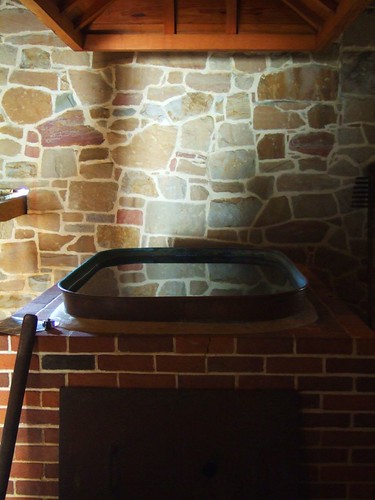
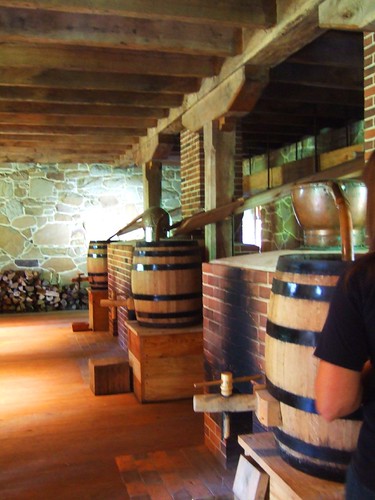
The Whiskey Distillery at Mt Vernon.

On day two of my travels in our nation's capitol, I piled in the car with my friends Bryan and Katie, and made the drive to George Washington's home, Mt. Vernon.

It was a spectacularly beautiful fall day, and there was no where I would have rather been that driving along the Potomac with the windows down. The three of us lunched at the Mt. Vernon Inn, which offers "...six intimate dining rooms, two with fireplaces, all with colonial charm, colonial servers, and delicious regional and colonial cuisine."


I had the "Colonial Turkey Pye," (the "y" makes it old timey) which was ok, but unimpressive. I think the vegetables were from a frozen bag mix, and it had a giant Ritz cracker hat. Bryan had a cup of peanut soup, which I had tried before at the cafeteria at Gettysburg. I had liked it at Gettysburg, but here it tasted like warm peanut butter. Gross.

The main disappointment was that the menu had foods that could have been eaten in the 18th century, like roasted chicken and corncakes, but the foods weren't at all different from what we eat today. There wasn't even an effort to use spices appropriate to the 18th century. It's dull; I never understood why "historic" restaurants never make the effort to offer interesting, delicious historic food.

We spent a few hours touring the grounds, and took a fairly boring tour of the Mansion itself. The house sees a high volume of visitors each year, and the staff handles this by scooting a continuous line of tourists along a velvet-roped route through the interior of the building, while reciting the interpretation for each space on a continuous loop. You would enter the room at the beginning of the interp, and leave approximately when it would start repeating. It was weird. One fact did catch my attention: Washington died suddenly of an inflammation of the throat, that suffocated him in 36 hours. I got a little freaked out when I felt a cold coming on a few days later.

Next, we went to Mt. Vernon's second site which features a reconstruction of Washington's Gristmill and Distillery. I had been looking forward to visiting the recently opened distillery for awhile, and it really was a treat. A knowledgeable interpreter talking us through the distilling process while we toured a truly beautiful building. I learned that in the 18th century, whiskey was made from rye, with a little corn. It was not aged; the entire distilling process took only two weeks before it was casked and sold. The liquor was clear, and our guide described it as tasting surprisingly sweet. Mt. Vernon will begin selling its whiskey sometime in the next year, and I am excited to try it when they do.
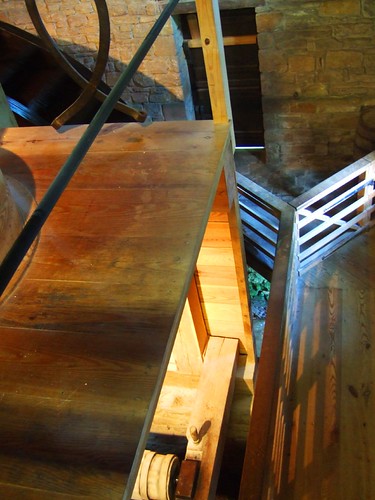
The gristmill was also neat, as gristmills are. Every time I stand before a spinning water wheel, and all those gears and grindstones, I'm impressed by human ingenuity. Who thinks of these things??

Looking down from the second floor of the gristmill, to the stream below.

I picked up a little souvenir treat for myself: a 5-ounce block of American Heritage Chocolate, a product of the Historic Division of Mars, that is made from an authentic Colonial recipe. I'm going to use it to make "Chocolet Puffs," a receipt from a 18th century manuscript that is one of the earliest instances of chocolate being used in another manner than for drinking. If the recipe turns out well, they will be sold at The City Reliquary's 1st Annual Haveymeyer Sugar Sweets Festival on Saturday. But more on that tomorrow.

See more images from my trip below.

February 21, 2009

Martha Washington's Great Cake

In honor of our first president's birthday, I wanted to share the recipe for Martha Washington's infamous big-ass cake.

From the Mount Vernon website, Mrs. Washington's Original Recipe:

"Take 40 eggs and divide the whites from the yolks and beat them to a froth. Then work 4 pounds of butter to a cream and put the whites of eggs to it a Spoon full at a time till it is well work'd. Then put 4 pounds of sugar finely powdered to it in the same manner then put in the Yolks of eggs and 5 pounds of flour and 5 pounds of fruit. 2 hours will bake it. Add to it half an ounce of mace and nutmeg half a pint of wine and some fresh brandy.

Notes on making Martha Washington's Great Cake:

In making the great cake, Mount Vernon's curatorial staff followed Mrs. Washington's recipe almost exactly. Where the recipe called for 5 pounds of fruit, without specifying which ones, 2 pounds of raisins, 1 pound of currants, and 2 pounds of apples were used. The wine used was cream sherry. Since no pan large enough was available to hold all the batter, two 14 layers were made and stacked (note: the original was one single tall layer). The layers were baked in a 350 degree oven for 1.5 hours. Should be iced with a very stiff egg-white based icing, flavored with rosewater or orange-flower water."


And in the spirit of the Month of Presidents, and the ongoing celebration of Lincoln's 200th birthday, Dj Bryan sent me this post on What about the plastic animals? about Mary Todd Lincoln's White Almond Cake:

"The Lincoln Home National Historic Site has the recipe, which I assumed was authentic. It turned out well. The recipe called for six whipped egg whites to be folded into the batter. That made the cake fairly light, but still denser than an angel food cake...

Another recipe still has me scratching my head. And I quote: 'Because I love a challenge, I took this recipe home and made Mary Todd Lincoln's cake. Even with today's modern technology, the process was slow going. In all, it took about four hours to cream the butter, whip the egg whites, chop the almonds and get it all mixed and baked. I used a mixer and a mini chopper...'

Four hours? Discount the baking time and there's still three hours left. What task could have possibly taken three hours? I don't mean to brag but it took me all of 15-20 minutes using an electric hand mixer, a mini food processor, and a large wooden spoon. Did she shell, peel and blanch the almonds? Were the almonds chopped one at a time? Did she forget to mention that she has no arms? I am baffled."

Me too. Happy Birthday, Presidents!