Showing posts with label taste history today. Show all posts

November 18, 2009

Taste History Today: Jefferson's Favorite Apple


Photo by Brandon Miller

The premiere issue of Edible Queens has a feature on the Newtown Pippin apple, a heritage breed with it's origin in the New York area. From the U.S. Apple Association:
"Also known as Albemarle Pippin, a favorite variety of Thomas Jefferson. Discovered on Long Island in 1759, this apple is one of the oldest original U.S. varieties, helping to launch the U.S. fruit export industry. Newtown Pippin is a distinctive green, often with yellow highlights. Its aromatic, tangy flesh makes the Newtown great for use in pies and applesauce. Primarilly a processing variety, most U.S. supplies are used commercially. Newtown Pippin is typically available from September through December."
Jefferson dubbed the Newtown "The Prince of Apples" and grew them on his Monticello estate. The Newtown is making a comeback in the New York area thanks to Erik Baard, a Long Island City–based environmentalist.
"Since 2006, Baard has spearheaded a local movement to plant Newtown Pippin saplings across the city and state. “I’m trying to remind New Yorkers of our agricultural heritage one tree at a time,” explains Baard, the borough’s own Johnny Appleseed.
The Newtown Pippin—a pippin is an apple grown spontaneously from seed—first took root in the Newtown section of Queens, now Elmhurst, in the 1700s, and was almost universally lauded as one of the best-tasting apples ever grown. (Edible Queens)”
You can get your hands on Newtown Pippins in New York at the Red Jacket Orchard stand at the Union Square Greenmarket on Mondays. They sell other heirloom breeds including Baldwin, Staymen Winesap, 20 oz pippin and Northern Spy.

I'm going to be featuring the Newtown Pippin at the Old Stone House event this Sunday: stop by to see the apples for yourself and for a taste of apple-rosewater tart.

August 14, 2009

Taste History Today: Ossabaw Pork

From the ossabaw tasting dinner at Boqueria

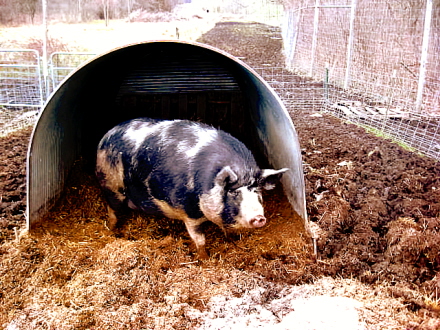
New York chefs have been going ga-ga about a new type of upscale pork, that is actually from a very old breed: The Ossabaw.

"The Ossabaw breed is descended from some of the 700 animals left along the Southeast coast by Spanish explorer Hernando De Soto in 1539. The idea was that the hogs would give future colonists a ready supply of meat.

The swine left behind were Ibericos, which Spaniards let graze on acorns and then cured into their famous Jámon Iberico, a flavorful pink ham with droplets of fat that makes pork lovers swoon...Although many of the Ibericos in America eventually died out or assimilated with dominant barnyard breeds over the years, some Ibericos remained genetically pure. These are the Ossabaws, whose name comes from the remote Georgia barrier island where the breed thrived in the wild for centuries. (The News and Observer: High on this Hog)"

There has been a recent movement to save the pig, by breeding it and marketing it's meat to upscale restaurants, mostly in New York. "It's oxymoronic to think that eating a rare breed is actually saving it, but it's true," said Chuck Bassett of the American Livestock Breeds Conservancy of Pittsboro. I've never tasted it, but the meat is supposed to be exquisite.

"Only a few Mennonite farmers agreed to industry-defying lunacy: raising these pigs in the open, and finishing them on acorns, beech and hickory nuts. The six-week autumn feast lays on an incredible layer of burnished yellow, nutty-tasting fat. At 250 to 300 pounds each, 40 Ossabaws are slaughtered each autumn, and the parts sent off to people ready to accord them due reverence.

The back fat was doled out to a who’s who of four-star and locally focused enclaves. Everyone from Craft and Craftsteak, Aureole, Blue Hill at Stone Barns, Gramercy Tavern,Café Boulud, and Four Seasons, to Savoy, A Voce, Tao, Tabla, Morandi and Commerce got their slab. Salumeria Biellese takes the bellies for pancetta, the front legs for coppa(thanks, shoulders) and the trim for cured salami including sopressata and cacciatorini. (Time Our New York: Ossabaw Pig Legs Ready for the Eatin')"


The meat is also occasionally available at Murray's Cheese. You can see the pigs in the flesh at Mt. Vernon, in Washington DC, where they are bred every spring. Ossibaw is also being championed because it is raised organically on wild forage, and it's fat has healthy properties similar to olive oil. I've heard, however, that they can be extremely aggresive, particularly the males.


For more on this heritage breed, read this great article at Rural Intelligence.