March 12, 2010

THIS BLOG HAS MOVED TO http://www.fourpoundsflour.com/


You are about to be redirected.


This blog has moved to: http://www.fourpoundsflour.com/

I've completely redesigned this blog, and moved it to wordpress.  Take a look!  
If you are following this blog at http://www.fourpoundsflour.blogspot.com,  please update the address to http://www.fourpoundsflour.com/feed/

Please let me know if you have any technical difficulties.

Make this switch with me!  It will enable me to deliver more content, more efficiently.  I'll see you there!

Sarah

March 11, 2010

Snaphot: Pinons

Pine nuts.

My friend Cecile is visiting from Belgium, and she brought me a little gift: pine nuts, collected during a hike in the south of France.  I've never even seen a pine nut in it's shell before!  I'm going to make something really special with these; perhaps some Pignoli Cookies.

March 10, 2010

Travelogue: Chickens Cooked in Bladders

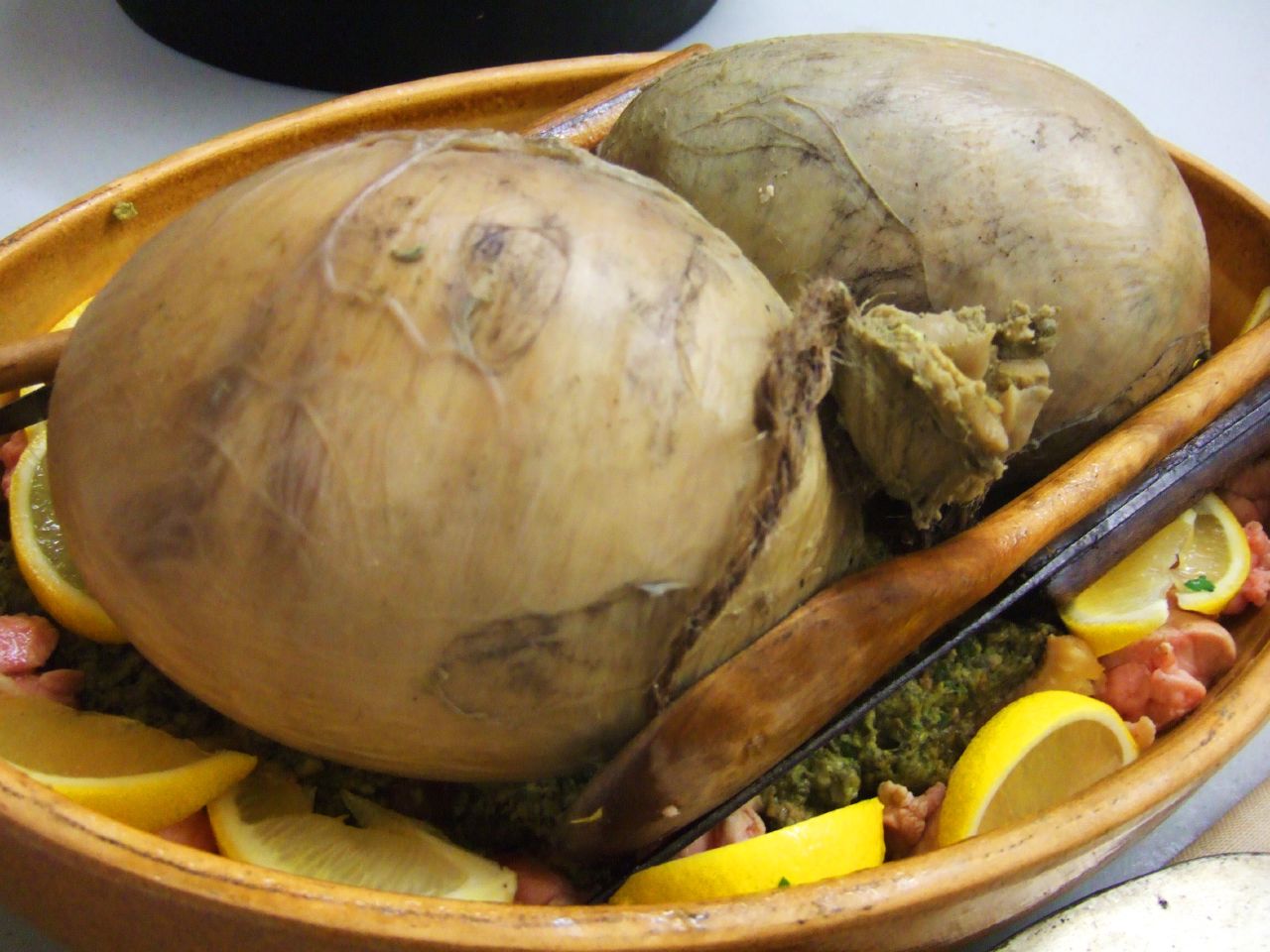
Left: My teacher proudly displays a chicken stuffed into a bladder. 

The weekend before Pancakes Aplenty, I took a trip down to Pennsbury Manor, the recreated historic homestead of William Penn.  I attended a hearth cooking workshop by Past Masters in Early American Domestic Arts to brush up on my skillz.

The featured recipe we recreated was from an 18th century source, "Chickens in Bladders."  You essentially take two small chickens, stuff them with a bread crumb and oyster dressing, then tuck meatballs under the skin, then shove the whole thing in a cow's bladder.  Our teacher, Clarissa, stretched out the cow's bladders by cutting off one end and forcing her hands inside, in procedure that looked either like a reverse birth or an old timey freak show.  The chickens were then coerced inside and the whole thing was boiled for about two hours.  When they came out, they looked like human balloons.

Forcing a chicken into a cow bladder. Photo by Carolina Capehart.


The finished chicken.  The bladders were cut open, the chicken removed and carved.

The bladders acted like a sausage casing, keeping all the stuffing in place.  The chicken meat was very tender, and flavorful, but the flavor was predominantly of oysters (not my favorite food).  It was served atop a "Coolio," and I was so distracted thinking about the rapper, that I think I may have missed what it actually was.  The full recipe, for your enjoyment, is below.  You can see more photos from the class here.

Take Ox-Bladders that are ready dry’d, and put them into warm Water to supple them: Cut off the Necks of the Bladders, to make Room for your Fowl to go in, but be sure to leave Room enough to tie them up close; then let your Fowl be drawn, singed, and truss’d to boil, the Legs* cut off, and truss’d close: Take Oysters, if three Fowls, to each a Quart, to a Chicken a Pint, set them, and beard them; take Lumps of Marrow, Chestnuts blanch’d, or Pistachoe-Nut Kernels; season with Pepper, Salt, and Nutmeg, Thyme and Parsly minc’d, and a little Onion; work this up together with grated Bread, a little Cream, and the Yolks of Eggs, and fill the Bellies full of it, and force under the Skin of the Breast with a little light forc’d meat: Put them in your Bladders, and tie them up fast, leaving Room that the Bladders may not break; boil them well, for they will require as much more boiling as without Bladders; then make a Coolio with a Sweetbread or two, a few Cocks-combs, a few Morelles and Trouffles; do not make it too thick; pout it in the Bottom of your Dish; lay your Fowl on it: You may cut off the Bladders, when they are cut up, the inside Forceing will mix with the Coolio: Garnish with Forc’d- meat and sliced Orange or Lemon, and serve it away hot. (The Complete Practical Cook by Charles Carter; London, 1730)

March 8, 2010

Events: Pancakes Aplenty! Wrap-up and Recipes

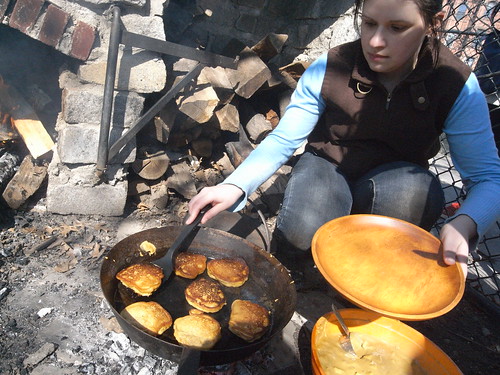
Cooking Apple, Sour Milk & Molasses Pancakes at Old Stone House yesterday.  See more photos from the event here.

I was too immersed in pancake making to know how many people came out to the event yesterday.  Take a look for yourself:


Despite a constant flow of pancakes, the line was this long for an hour and a half.  I was flabberghasted.

I want to thank everyone who was able to make it out yesterday, and thank you for waiting patiently and amicably while I furiously flipped flapjakes.  I simply was not prepared, nor was I expecting, to serve hearth-cooked pancakes for 200 people; I'm so pleased that everyone was able to get a taste, and (hopefully) went home happy.

If you enjoyed yourself, then I encourage you to make these recipes at home!  They work just as well on an electric skillet as they do over an open hearth--and it's probably a more efficient method of cooking.

Thank you again for the wonderful day; if you were able to attend, please leave your thoughts in the comments.  Enjoy the recipes, and I sincerely hope to see you at another event in the future.

***

Apple Pancakes
Adapted from The New England Economical Housekeeper by Esther Allen Howland, 1845.
Modern recipe adapted from The Old Sturbridge Village Cookbook, 3rd ed. by Jack Larkin, 2009.

The original recipes instructs the cook to deep fry these pancakes in lard, like a doughnut.  But I find this recipe works just as well fried with butter on a griddle or in a skillet.

2 cups sour milk or 1 1/2 cups fresh milk with 2 tablespoons lemon juice
2 baking apples
3/4 cup molasses
3/4 cup cornmeal
1 teaspoon baking soda
2 cups flour

1. Combine milk and molasses, whisking until emulsified.
2. Pare and core apples, and dice into 1/4 in. cubes.  Add to milk and molasses mixture and set aside.
3. In another bowl, whisk cornmeal, baking soda and flour until combined.  Using a wooden spoon or a spatula, create a well in the center of the dry ingredients.  Pour milk mixture into the well, and mix until combined.
4. Fry in a skillet or on a griddle, with a generous amount of butter.  Serve with maple syrup, butter, or a hard sauce.

Clove and Rosewater Pancakes
Adapted from The New England Economical Housekeeper by Esther Allen Howland, 1845

Rosewater can be food in the Indian or Middle Eastern section of your grocery store.

3 tablespoons sugar
½ tsp cloves
1 teaspoon baking soda
2 cups flour
¼ teaspoon salt
2 eggs, lighten beaten with
½ tsp rosewater
1 cup whole milk

1. Combine sugar, cloves, baking soda, flour and salt in a large bowl.  Whisk until combined; set aside.
2. Whisk the milk into the egg and rosewater mixture.
3. Using a wooden spoon or a spatula, create a well in the center of the dry ingredients.  Pour milk mixture into the well, and mix until combined.
4. Fry in a skillet or on a griddle, using a generous amount of butter.  Serve with maple syrup, butter, or a hard sauce.


Pumpkin Cornmeal Pancakes
Adapted from Food, Drink and Celebrations of the Hudson Valley Dutch by Peter G. Rose, 2009.

"Although (the Dutch) continued their own food ways, they did incorporate native foods into their daily diets. They did so, however, in ways that were familiar to them: for example, when they made pumpkin cornmeal pancakes (cornmeal instead of wheat flour) or pumpkin sweetmeat (instead of quince paste)."

-- Food, Drink and Celebrations of the Hudson Valley Dutch by Peter G. Rose

1 cup flour
1 cup yellow cornmeal
1 cup brown sugar
1/2 teaspoon nutmeg
1/2 teaspoon mace
1/2 teaspoon cloves
1 teaspoon baking soda
1 cup pumpkin puree
2 eggs, lightly beaten with
1 1/2 cups whole milk

1. In a large bowl, whisk together flour, cornmeal, sugar, and spices. Set aside.
2.  Whisk together egg and milk mixture with pumpkin puree until throughly amalgamated.  
3. Using a wooden spoon or a spatula, create a well in the center of the dry ingredients.  Pour milk mixture into the well, and mix until combined.
4. Fry in a skillet or on a griddle, with a generous amount of butter.  Serve with maple syrup, butter, or a hard sauce.

A Hard Sauce
From Miss Corson's Practical American Cookery and Household Management by Juliet Corson, 1886.

1 pound unsalted butter, room tempeature
2 cups sugar
½ cup white wine or brandy
1 tsp nutmeg or cinnamon (optional)

Beat in an electric mixer on medium until evenly combined.

March 2, 2010

Events: Pancakes this Sunday!

Do you know there are free pancakes at Old Stone House this Sunday? Pancakes made by me??  The official press release is below!

***

EVENT LISTING: Pancakes Aplenty
DATE:                            Sunday, March 7th
TIME:                            11am - 1pm.
LOCATION:              The Old Stone House in Washington Park5th Ave. at 3rd St.Brooklyn
DETAILS:               Stop by for brunch and a taste of the past at Brooklyn's Old Stone House. Historic gastronomist Sarah Lohman flips flapjacks over an open fire, and will recreate three historic pancake recipes: Pumpkin Cornmeal; Apple and Sour Milk; and Clove and Rosewater. Sure to tickle the modern palate, the pancakes will be served will all the fixins' as well as hot drinks.  Music for the little ones will be provided by Ivan Ulz, so bring the whole family. Presented by the New York Nineteenth Century Society and The Old Stone House. FREE
- More -
Sarah Lohman researches and recreates historic food, creating dishes that look, smell, and taste just like they did hundreds of years ago. She opens a delectable window to the past, letting her lucky tasters understand a little bit about another way of life. 

February 26, 2010

Snapshot: Wild Game at Henry's End

The Mixed Game Grill at Henry's End: Elk chop, venison sausage, and the wild boar belly is buried in back, under some sort of pomegranate chutney.

Last weekend, the Boyf took me out for a belated Valentines.  We ate some animals at the Wild Game Festival at Henry's End Restaurant in Brooklyn.  I had the Mixed Game Grill, pictured above, which included herb crusted elk chops; venison sausage; and wild boar belly.  I found the first two to be a little heavy on the seasoning; if I'm going to eat exotic animals, I want to taste their flesh!  The herb crust on the elk was overpowering, but after I scraped it off, I found the meat to be tender, juicy and flavorful.  The venison sausage was tasty, but tasted like herbs, not venison.  The boar belly had the purest flavor, and was well prepared.

The boyf had ostrich, pictured right, with coos coos.

February 24, 2010

Cocktail Hour: The Irish Rose

This beverage is another one  from my recent Pre-Prohibition birthday party.  Don't be fooled by it's cherry-pop color; the Irish Rose is a manly dose of whiskey perfectly co-mingled with a swig of grenadine.  We really don't drink enough grenadine these days.

This has become my favorite beverage for my four-o'clock Judge Judy cocktail break.  I think it will become yours, too.

***
The Irish Rose
From The Ideal Bartender by Tom Bullock, 1917.

1 oz. Grenadine
1.5 oz. Whiskey
Seltzer

Fill a glass with ice; a rocks glass or a tumbler will do.  Add grenadine and whiskey.  Fill glass with seltzer.  Stir until condensation appears on the outside of the glass and the contents are thoroughly mixed.  Serve and enjoy.

February 23, 2010

Events: Timeline of Taste at Trade School


On Sunday, I taught a class at Trade School; it was a brief (but edible) overview of the last 200 years of America's favorite flavors.  These photos were taken by my friend Ilana, and I think her description of the class sums it up best:

We feasted on treats from several time periods, "A Rich Cake" by Amelia Simmons from 1796 was by far my favorite. Dense and full of "stuff", it was AWESOME. Not to mention from a 1796 recipe to boot......
Speaking of the Trade School, however, holy moly what an amazing place. As per their website:
"Take a class every night with a range of specialized teachers in exchange for basic items and services. Secure a spot in a Trade School class by meeting one of the teacher’s barter needs."
So the classes are essentially free. Sarah's class cost me two dozen eggs. Can't be beat for such a wonderful range of classes in such a cozy space.
**Note on the above pics, unfortunately I was so engrossed in the class that I completely forgot about my camera till we got to the last recipe - a jokey take on Charlotte Russe, a popular 19th c. street food (ed. note: actually early 20th century street food, but a popular dessert in different forms since the 18th century). We made ours with store bought lady fingers, whipped cream from a can and maraschino cherries......yum? A take on 1950's convienence food.
Assembling Charlotte Russe.

This Charlotte Russe is a little bit sad--the Reddi Whip was warm, so it melted pretty fast.


On the left, "A Rich Cake" and on the right a currant cake from the 1840s.

One of my students brought me this lovely bottle of port as barter for my class.  She included a recipe for port wine fudge from her home state of California.  So nice!

Trade School is only around until the end of the month, so sign up for a class here.  And if you missed this event, never fear!  Pancakes Aplenty is on March 7th at Old Stone House.

February 22, 2010

Menus: Washington's B-day at Niblo's Saloon, Broadway

Eaten on this day in 1851 at Niblo's Saloon.  I think my favorite dishes are the Chicken Sallad and the Beef Tongues, both served in "gelee"; the Pigeons and the Widgeons; and (no party is a party without) Charlotte Russe.  I don't know which would have been my favorite ornamental piece; probably the Fruits of Industry.

February 17, 2010

Retronovated Recipes: Braised Turtle

I've been doing some research on turtle meat for my upcoming Edible Queens article and I wanted to share a great recipe that won't make it to print.  The reason?  The article is due out in June, and this slow braised, spicy dish is perfect for winter.  The taste of the tender meat will envelop you like a warm hug.

My inspiration was the first printed American recipe for turtle from Amelia Simmon's American Cookery.   I actually used veal to test this recipe, and I think it would be equally good with a cut of beef or lamb.  This dish is so easy and delicious, you should serve up some turtle meat surprise at your next Sunday dinner.

***
Braised Turtle
Inspired by "How to Dress a Turtle," from American Cookery by Amelia Simmons, 1796

1 lb fresh or frozen turtle, beef, or lamb.
2 c. beef stock
½ tsp salt
½ tsp black pepper
¼ tsp cayenne pepper
¼ tsp nutmeg
¼ tsp mace
½ tsp each dried thyme, marjoram, parsley and savory; mixed.
½ cup Madeira wine or sherry

1. Preheat oven to 400 degrees.

2. Rinse meat and pat dry; cut into one inch cubes.  In a bowl, toss turtle meat with salt, pepper, cayenne pepper, nutmeg and mace.

3. Add meat to a baking dish or dutch oven.  Sprinkle with herb mixture.  Pour in Madeira or sherry and beef stock. Cover, and bake for two hours.

February 15, 2010

Cocktail Hour: A Toast to the Presidents!

Simon Ford of Liqour.com adovocates the celebration of President's Day with Classic Cocktails:
"Franklin Roosevelt guzzled Martinis, Richard Nixon drank Cuba Libres (you have to love the irony) and Gerald Ford enjoyed the odd Gin & Tonic. Woodrow Wilson, president during the enactment of Prohibition, stashed away supplies so that he could mix his favorite libations in secret while the rest of the nation settled for bathtub gin and moonshine.
I think it’s fair to say that the proper way to celebrate Presidents’ Day (and the long weekend) is with cocktails. Here are a couple of historic drinks to get you started. Cheers!"
Read the full article here, and mix up a few classic cocktails appropriate to the Presidents.

February 8, 2010

Events: Venus in the Kitchen

There's a cute event coming up this Thursday in honor of Valentine's day. I'm not affiliated with it, but I am definitely attending!
Time Table presents a Valentine’s cocktail party featuring aphrodisiac food and drink from the 1952 book, "Venus in the Kitchen: Or Love’s Cookery Book". Come single or with a sweetie and spend some time sampling love potions of the early 50’s. We can’t make any promises on the power of these wacky concoctions—but we can promise a good time. Feel free to dress the part, though modern-day attire is just fine. 

**Tickets are $5 each and can be purchased at WORD or through our website**

http://www.wordbrooklyn.com/product/venus-kitchen-event-ticket

With a menu like this, be sure not to miss it!


Jessica Reed is a Greenpoint-based artist, writer, and amateur culinary historian interested in the intersections between food, history, art, and culture. Time Table, her most recent project, invites guests to taste the past at small gatherings serving food and drink made from period recipes, and utilizing period serving pieces and decorative elements whenever possible. Her ambition is to bring people together with food as a means of connecting with our shared history.

February 3, 2010

Cocktail Hour: Apple Toddy


February is the coldest month in New York City.  Although I know that the spring thaw is just around the corner, the bitter wind that whips off the East River makes me die a little bit inside. Every day.

To keep the frigid weather at bay, I've been investigating winter cocktails.  Nothing beats the wintertime blues like hot water and alcohol.  I've been eyeing up this cocktail for awhile: the Apple Toddy.  It comes from my favorite cocktail book, the first cocktail book, Jerry Thomas' How to Mix Drinks.

For my version of this recipe, I used delicate, little Lady Apples, which I found in my local grocery store.  Feel free to use a large baking apple, cut into slices.  Apple Brandy can be found at most liquor stores or ordered online.  Laird's has been making apple jack and apple brandy in America since 1780.

Oh that's good.  I feel warmer already.


***
Apple Toddy
Inspired by a recipe from How to Mix Drinks, by Jerry Thomas 1862.

Baking Apples: three small apples or one large
1/4 cup light brown sugar
1/8 tsp mace (or cinnamon, if you prefer)
1/8 tsp nutmeg
Unsalted butter
2 ounces apple brandy
Hot water

1. Preheat oven to 350 degrees.  Core apples and place in a baking dish.  Mix sugar and spices.  Fill the center of the apples with sugar mixture and sprinkle the remainder around the edges.

2. Bake apples for 30 minutes, or until tender.

3. Scoop one apple (or apple slice) into the bottom of a rocks glass or mug.  The bottom of the baking dish should be filled with sugar syrup; add one tablespoon of this syrup to your glass.

4. Add two ounces apple brandy, then fill glass to the top with hot water. Stir gently until the sugar syrup has dissolved.

5. Grate a little nutmeg on top and serve.

***

February 2, 2010

Events: Save the Dates for Cakes, Pancakes, and Beer.

Want a mouth full of history? Then mark your calender for these free events!

Sunday, February 21st
A Timeline of Taste: A Brief Overview of the Last 200 Years
4:30pm - 5:30pm
At Trade School
139 Norfolk Street, New York, NY
Free for barter.

I'm offering an hour-long class through Trade School.
Our idea of what “tastes good” is constantly changing. In this class, we will take a look at the constant flux of America’s culinary preferences, from the publication of the first American cookbook in 1796 to the swell of convenience food in the 1940s and 50s. To inspire our discussion, we will be sampling four different cakes from four different eras, and will make one of these desserts in the class. And with your help, we’ll bring our exploration to the present day with a selection of contemporary dishes.
Trade School offers these classes through a barter system; when you sign up, you can choose to bring a small item to trade for the class. There are a limited number of seats available, so reserve yours today! Sign up here.


Sunday, March 7th
Pancakes a Plenty!
11am - 1pm
At Old Stone House
336 3rd Street
Brooklyn, NY 11215
Free

Brought to you by the New York 19th Century Society.
Old Stone House lights up its hearth for a spring pancake celebration, featuring culinary creations by historic gastronomist Sarah Lohman. Pancakes a Plenty! presents three historic pancake recipes sure to please the modern palate: Pumpkin Cornmeal; Apple and Sour Milk; and Clove and Rosewater.
Pulled from the pages of 18th and 19th century New England cookbooks, these recipes have the flavor of New York life from another era. Prepared over an open fire, the pancakes will be served with all the fixins’ as well as hot drinks.
We'll keep serving pancakes until the pancakes run out. So stop by and sample some slapjacks


Saturday, April 10th
The Boston 19th C. Pub Crawl
Starting at 5:30pm
Meet at Eastern Standard
528 Commonwealth Avenue
Boston, MA
Free, but drinks are additional.

We're taking the 19th Century Pub Crawl on the road to Boston! The evening will start at Eastern Standard, a contemporary bar that "...Breathe(s) life into forgotten cocktails of the past as well as conjuring up new classics." They'll be featuring several cocktails for the Crawl, including their house special the "19th Century," and offering a selection of house-made hors d'oeuvres. From there, we'll crawl to Boston's oldest pubs, some stretching back to the 17th century! Our proposed route (subject to change) can be found here.


Saturday, May 15th
The New York 19th C. Pub Crawl
Starting at 6pm
Meet at Madame X
New York, NY
Free, but drinks are additional.

In the wake of last fall's amazing New York 19th C. Crawl, we're planning a whole new route! This spring, visit some of New York's oldest taverns and most notorious dens of vice on 10th Ave. Formerly along Manhattan's western waterfront, these inns served sailors drinks, drafts and entertainment. Our proposed route (subject to change) can be found here.

February 1, 2010

History Dish Mondays: Turtle Soup

Photo by Everett Bogue

Yesterday, I cooked up a batch of a popular 19th century summertime treat, Turtle Soup.  It went over surprisingly well with my friends!  But you'll have to wait to read more about it: I was testing my turtle recipe for an upcoming article in Edible Queens magazine.  The Summer 2010 issue will feature this dish and many more.

January 29, 2010

In The News: Booze News


The Secret Bowling Alley: "We recently purchased a building in Queens, and while clearing out the basement we discovered a two lane manual bowling alley in very good condition. We did some research and this basement was most probably a club during the Prohibition era."  (The Huffington Post)

Will Bitters Shortage Finally Kill Old Timey Cocktail Trend?:  "There has been a shortage. You can't just turn on and off supply of bitters. It's not like producing bottled water - it's a very delicate, intricate process." Invented in 1824 by a German doctor and made from a secret recipe of herbs, barks, roots, spices and rum, bitters became popular in Britain as an additive for gin, partly to conceal quinine in tonic water." (Gothamist)

Depression era cocktails at Depression era prices! Bars specializing in Prohibition era cocktails are now catering to those hit by the recession. (Liqour.com)

January 27, 2010

The Gallery: Big Cheese in the White House


"Big Cheese in the White House: Admirers of the President Andrew Jackson presented him with a 1,400-pound wheel of cheese shortly before he left the White House in 1837.  Jackson invited members of the public to eat the cheese; it was disposed of within two hours." The Oxford Encyclopedia of Food and Drink in America, Andrew F. Smith (Editor).

January 25, 2010

History Dish Mondays: Bazmaawurd, Mulahwajah and Juudhaab


Bazmaawurd ready to be rolled.

A few weeks ago, I mentioned the article Cooking with the Caliphs, which analyzed a medieval cookbook from the court of 10th century Baghdad:

"A little over a thousand years ago, an Arab scribe wrote a book he titled Kitab al-Tabikh (The Book of Recipes)... The book has come down to our time in three manuscripts and fragments of a fourth—and what a treasure it is. These are the dishes actually eaten by the connoisseurs of Baghdad when it was the richest city in the world."

Yesterday, I had a few friends over, and we tried some of these 1,000 year old dishes.

To begin, I presented Bazmaawurd: chicken, walnuts, fresh herbs and lemon (it was supposed to be citron, but I couldn't find one fresh) rolled up in a Lavash.  I think this was everyone's favorite.  The flavors were so fresh, light and zesty.  I found it to be a little dry--but it went nicely with some labneh.

Next I dished up a seasoned lamb dish called Mulahwajah, of which I neglected to take any photos (tipsy).  I stewed lamb meat with leeks, onions, a cup of water, and a fascinating spice blend:  coriander, cinnamon, caraway, pepper, and galangal.  The latter is a spice with a light, flowery, almost citrus taste.  And this recipe calls for a lot of spice: 5 1/2 teaspoons for a 1/4 pound of meat.  It covered the meat completely, but lamb has such a pungent flavor it stands up well to heavy spicing.  The result was a dish that blurred the boundary between sweet and savory with flavor unfamiliar to western tongues.

Lastly, I made Juudhaab: "The supreme roast meat dish was juudhaab (or juudhaabah), where the meat was served on a sweet pudding which had been baked at the bottom of the tannur to catch its dripping juices."   This dish is vaguely similar to Yorkshire Pudding, in that a soft bread is cooked using fat from the meat it is served with.  But the resemblance is remote; in fact, I have never heard of a food prepared quite this way before.


***
Juudhaab
From Kitab al-Tabikh by Abu Muhammad al-Muzaffar ibn Sayyar, approx. 945 AD
Translated by Linda Dalai Sawaya for Cooking with the Caliphs.


1 whole chicken
¼ cup plus 2 tablespoons rosewater
ground saffron
1 pound dried apricots
2 fresh lavashes, pitas or other flatbreads, 12" in diameter (or more, if smaller)
½ cup brown sugar

1. Preheat oven to 500 degrees. Place apricots in small saucepan, add water to cover apricots by ½ inch. Bring to a boil and stew until apricots are soft and the water has reduced to a thin syrup, about 15-20 minutes.

2. In a baking pan or bottom of a broiling pan, place one lavash.  Strew with apricots in syrup, sugar and 1/4 cup rosewater in which pinch of saffron has been dissolved, then cover with remaining lavash.  Cover with a wire rack or top of the broiling pan.

3.  Wash chicken and pat dry. Mix 2 tablespoons rosewater with pinch of saffron and rub on chicken, inside and out. Place on rack or on broiling pan.

4. Bake at 500 degrees for 20 minutes, then turn heat down to 325.  Roast until a thermometer inserted into the thickest part of the thigh reads 160-165.

5.  Carve chicken and serve in slices over the lavash and apricot pudding.

***

The result was interesting: I wasn't thrilled with the slightly greasy taste and texture of the sweet pudding.  But my guests tore into it with grunts and "mmm"s.  The lone vegetarian was mortified.  But we still love her.

Check out all of these recipes and more in the original article here.

January 21, 2010

In the News: Meat, Meat, MEAT


A pig's head made from newspaper, wire mesh, and clay.  Not your grade school craft project. (historicfauxfood.com)

Head's up! The Brooklyn Beefsteak is back February 20th.  Stay tuned into their blog for updates here, and read my write up of their fall event here.

The New Age Cavemen and the City:  A group of New Yorkers swear by the Paleo Diet, which involves eating and exercising like a caveman. (nytimes)

Historic Faux Foods: "Sandy Levins researches the foodways of bygone eras to create historically-accurate individual faux foods as well as entire period table and room settings. " Rendered in astounding accuracy--check out her website.