February is the coldest month in New York City. Although I know that the spring thaw is just around the corner, the bitter wind that whips off the East River makes me die a little bit inside. Every day.
To keep the frigid weather at bay, I've been investigating winter cocktails. Nothing beats the wintertime blues like hot water and alcohol. I've been eyeing up this cocktail for awhile: the Apple Toddy. It comes from my favorite cocktail book, the first cocktail book, Jerry Thomas' How to Mix Drinks.
For my version of this recipe, I used delicate, little Lady Apples, which I found in my local grocery store. Feel free to use a large baking apple, cut into slices. Apple Brandy can be found at most liquor stores or ordered online. Laird's has been making apple jack and apple brandy in America since 1780.
Oh that's good. I feel warmer already.
*** Apple Toddy
Inspired by a recipe from How to Mix Drinks, by Jerry Thomas 1862.
Baking Apples: three small apples or one large
1/4 cup light brown sugar
1/8 tsp mace (or cinnamon, if you prefer)
1/8 tsp nutmeg
Unsalted butter
2 ounces apple brandy
Hot water
1. Preheat oven to 350 degrees. Core apples and place in a baking dish. Mix sugar and spices. Fill the center of the apples with sugar mixture and sprinkle the remainder around the edges.
2. Bake apples for 30 minutes, or until tender.
3. Scoop one apple (or apple slice) into the bottom of a rocks glass or mug. The bottom of the baking dish should be filled with sugar syrup; add one tablespoon of this syrup to your glass.
4. Add two ounces apple brandy, then fill glass to the top with hot water. Stir gently until the sugar syrup has dissolved.
Want a mouth full of history? Then mark your calender for these free events!
Sunday, February 21st A Timeline of Taste: A Brief Overview of the Last 200 Years
4:30pm - 5:30pm
At Trade School
139 Norfolk Street, New York, NY
Free for barter.
I'm offering an hour-long class through Trade School.
Our idea of what “tastes good” is constantly changing. In this class, we will take a look at the constant flux of America’s culinary preferences, from the publication of the first American cookbook in 1796 to the swell of convenience food in the 1940s and 50s. To inspire our discussion, we will be sampling four different cakes from four different eras, and will make one of these desserts in the class. And with your help, we’ll bring our exploration to the present day with a selection of contemporary dishes.
Trade School offers these classes through a barter system; when you sign up, you can choose to bring a small item to trade for the class. There are a limited number of seats available, so reserve yours today! Sign up here.
Sunday, March 7th Pancakes a Plenty!
11am - 1pm
At Old Stone House
336 3rd Street
Brooklyn, NY 11215
Free
Old Stone House lights up its hearth for a spring pancake celebration, featuring culinary creations by historic gastronomist Sarah Lohman. Pancakes a Plenty! presents three historic pancake recipes sure to please the modern palate: Pumpkin Cornmeal; Apple and Sour Milk; and Clove and Rosewater.
Pulled from the pages of 18th and 19th century New England cookbooks, these recipes have the flavor of New York life from another era. Prepared over an open fire, the pancakes will be served with all the fixins’ as well as hot drinks.
We'll keep serving pancakes until the pancakes run out. So stop by and sample some slapjacks
Saturday, April 10th The Boston 19th C. Pub Crawl
Starting at 5:30pm
Meet at Eastern Standard
528 Commonwealth Avenue
Boston, MA
Free, but drinks are additional.
We're taking the 19th Century Pub Crawl on the road to Boston! The evening will start at Eastern Standard, a contemporary bar that "...Breathe(s) life into forgotten cocktails of the past as well as conjuring up new classics." They'll be featuring several cocktails for the Crawl, including their house special the "19th Century," and offering a selection of house-made hors d'oeuvres. From there, we'll crawl to Boston's oldest pubs, some stretching back to the 17th century! Our proposed route (subject to change) can be found here.
Saturday, May 15th The New York 19th C. Pub Crawl
Starting at 6pm
Meet at Madame X
New York, NY
Free, but drinks are additional.
In the wake of last fall's amazing New York 19th C. Crawl, we're planning a whole new route! This spring, visit some of New York's oldest taverns and most notorious dens of vice on 10th Ave. Formerly along Manhattan's western waterfront, these inns served sailors drinks, drafts and entertainment. Our proposed route (subject to change) can be found here.
The Secret Bowling Alley: "We recently purchased a building in Queens, and while clearing out the basement we discovered a two lane manual bowling alley in very good condition. We did some research and this basement was most probably a club during the Prohibition era." (The Huffington Post)
Will Bitters Shortage Finally Kill Old Timey Cocktail Trend?: "There has been a shortage. You can't just turn on and off supply of bitters. It's not like producing bottled water - it's a very delicate, intricate process." Invented in 1824 by a German doctor and made from a secret recipe of herbs, barks, roots, spices and rum, bitters became popular in Britain as an additive for gin, partly to conceal quinine in tonic water." (Gothamist)
It was my birthday last weekend, January 15th to be exact, which also happens to be the day before prohibition went into effect in 1920. So I decided to throw a "Drink Like Prohibition Starts Tomorrow" party.
I selected pre-prohibition cocktail recipes for gin, rum, whiskey, applejack, absinthe, champagne and beer. I provided a table full of mixers, tools, garnishes--everything my guests would need to shake up their own classic cocktails.
Most of the recipes I selected came from Tom Bolluck's 1917 book The Ideal Bartender. But two of the more interesting recipes I pulled from Sloppy Joe's Bar Guide. Published in 1932 (originally 1931), the book features recipes from Sloppy Joe's, a bar located in Havana, Cuba that was freqeunted by the likes of Clark Gable and Ernest Hemmingway. I first learned about this book while researching the origins of the Mojito; the first printed recipe for a Mojito appears in this book.
An interesting note, this drink appears in the section labeled "Bacardi Drinks." Barcardi was preferred for this drink because it was a filtered rum: it had a light flavor and was clear.
*** Mojito
From Sloppy Joe's Bar Reprint Season 1932-1933 by Jose Abeal and Ross Bolton
I served this drink in a rocks glass; should you want to make a full 8 oz. drink, I recommend doubling these proportions.
1 tsp sugar or simple syrup
Juice of 1/2 a Lemon
1.5 ounces rum
Seltzer Water
Fresh Mint
Shell of Lemon
Fill a glass with ice. Add sugar, and lemon juice. Add rum, and fill glass with seltzer water. Add 4-6 leaves of fresh mint. Stir cocktail until condenesation appears on the outside of the glass. Add the lemon shell and serve.
***
This drink was a real standout for me over the evening: I felt like it was a revelation in drinking and a vast improvement over contemporary Mojitos. The flavor is light, refreshing, and just the right amount of sweet. It reminded me of the fresh squeezed lemonade I used to get at the county fair--but boozier.
However, I read through the modern introduction to Sloppy Joe's after the party, and found this:
"Note that in this book any mention of lemon, may actually be lime. This mess up is proven in the bilingual Bar La Florida Cocktails Guide that translates lime incorrectly from Spanish."
So in retrospect the drink probably should have been made with lime--but the lemon juice was delicious.
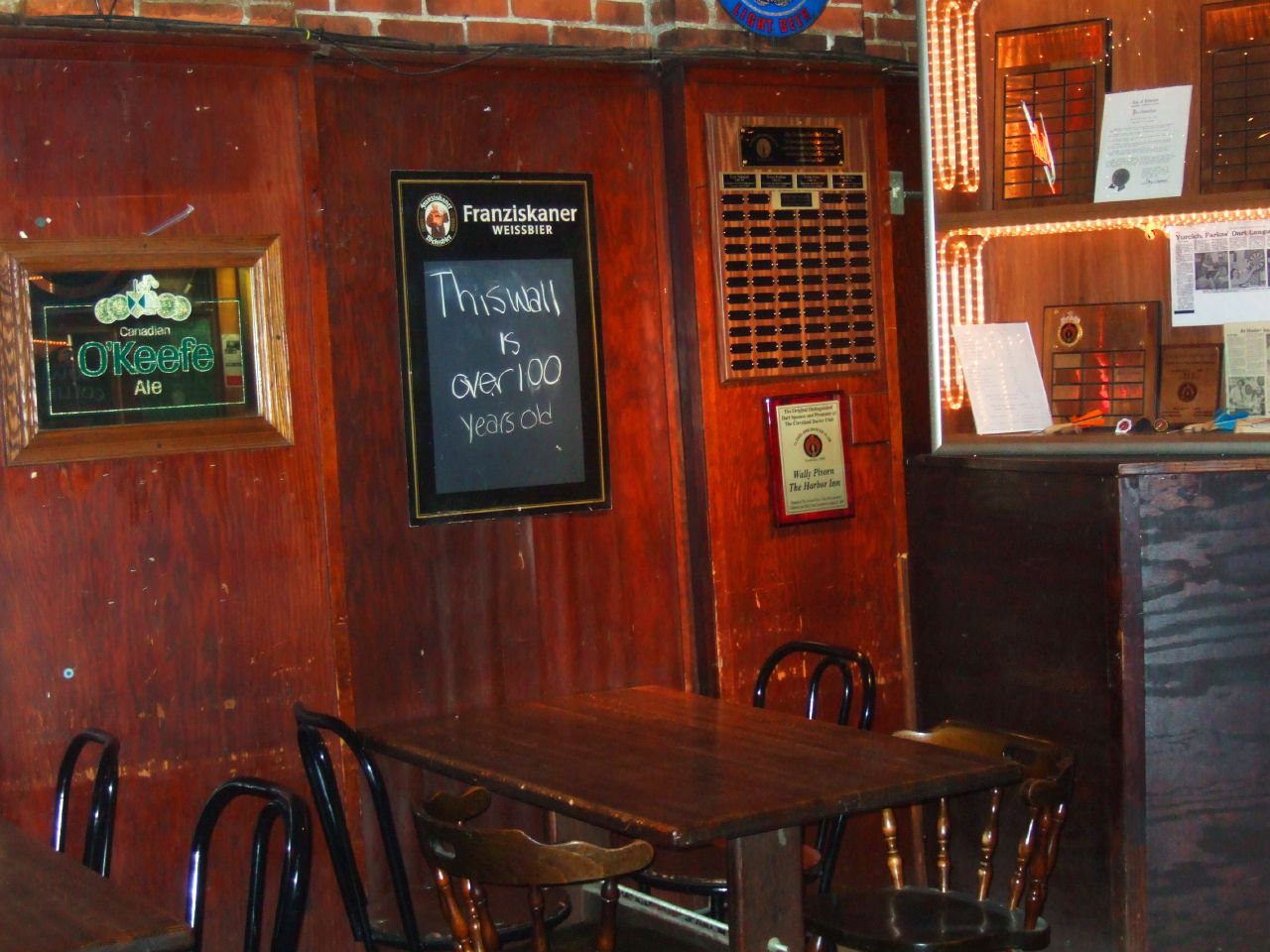
"This wall is over 100 years old." Inside Cleveland's oldest continually operating bar, the Harbor Inn.
I'm in my hometown of Cleveland for the holidays, a city I love very much. My heart breaks to see it looking so threadbare in this recession. My friends and I decided to celebrate our city via a journey into Cleveland history: a crawl of Cleveland's oldest pubs and bars that tip their hats to a bygone era.
Our first stop was Edison's Pub, a local bar that pays tribute to Thomas Edison. We started there mostly because it was a convenient meeting spot for the attendees, but the $2.50 happy hour drink special wasn't bad either. Cleveland, you truly are the land of plenty!
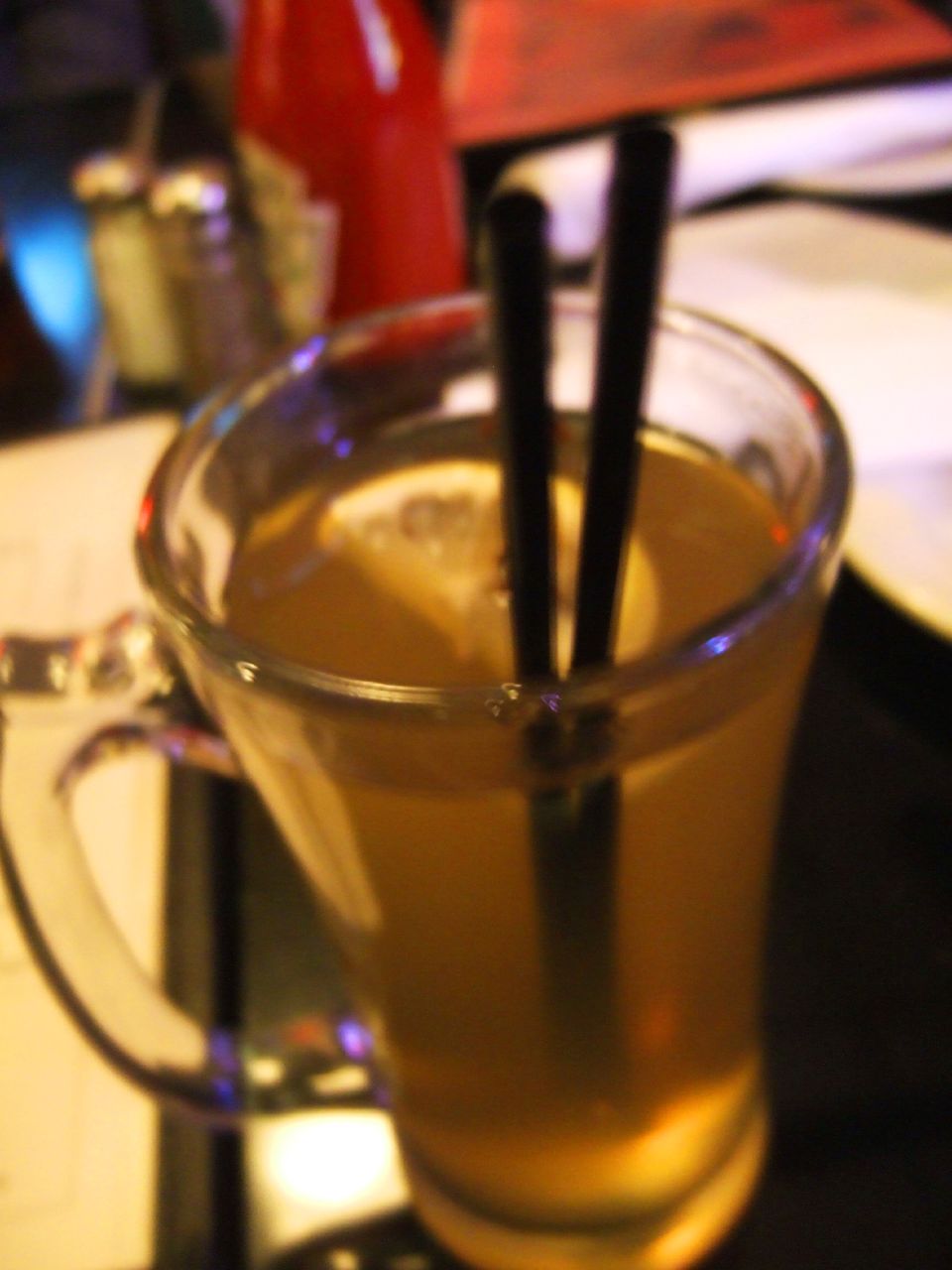
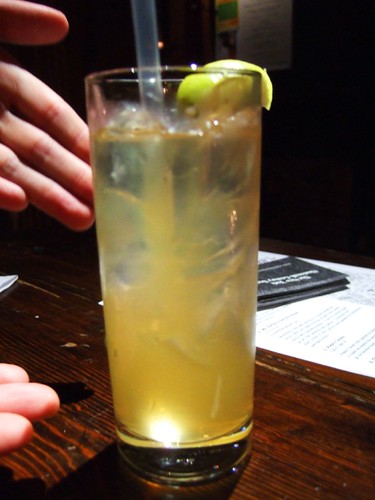
Next up was the Prosperity Social Club. Although it resides in what was a 1938 ballroom, the atmosphere was more 1950s VFW hall. However, as someone pointed out, it was very traditional, old-school Cleveland. We dug it. It was easy to picture iron workers coming in from the cold for a drink, and the bar is still warmed by a vintage wood-burning stove. I drank a hot whiskey, a comforting combination of Jameson, honey, lemon and clove. Good for what ails 'ya. I recommend it, as well as the pierogies, the next time you're there.
Right: Hot Whiskey at the Prosperity Social Club
We jumped in a cab and headed north, stopping at Cleveland's new mixology sensation, the Velvet Tango Room. From their website:
"At the Tango Room, we believe in craft. We believe that the right combination of ingredients can take you back in time, to a porch in Key West, a beach in Bermuda, a shadowy speakeasy in New York, or a glittering bar in Paris. When you sit at our bar, we want you to connect to those places and that history, so we carefully research old cocktail recipes, lovingly resurrecting classic drinks with historically accurate ingredients."
Sounds right up my alley, doesn't it? It's pricier than most Cleveland bars, at $15 a drink, but it's worth it. The cocktails taste like a sip of history, respectfully revived and celebrated. I had a pisco sour (Peru's national drink!) and I plan on returning soon for one of their carefully crafted Manhattans.
This bar is incredibly popular in Cleveland: five years ago, when I was working on my thesis, everyone said a venue like this could never survive locally. As it turns out, perhaps a historically innovative place like the Tango Room is exactly what Cleveland needs.
Next we walked a few blocks past the Westside Market, and into the Great Lakes Brewery. GLB is know for its beers named after famous Clevelanders and events from the city's history. It's housed in what was once the Market Tavern, est. 1865.
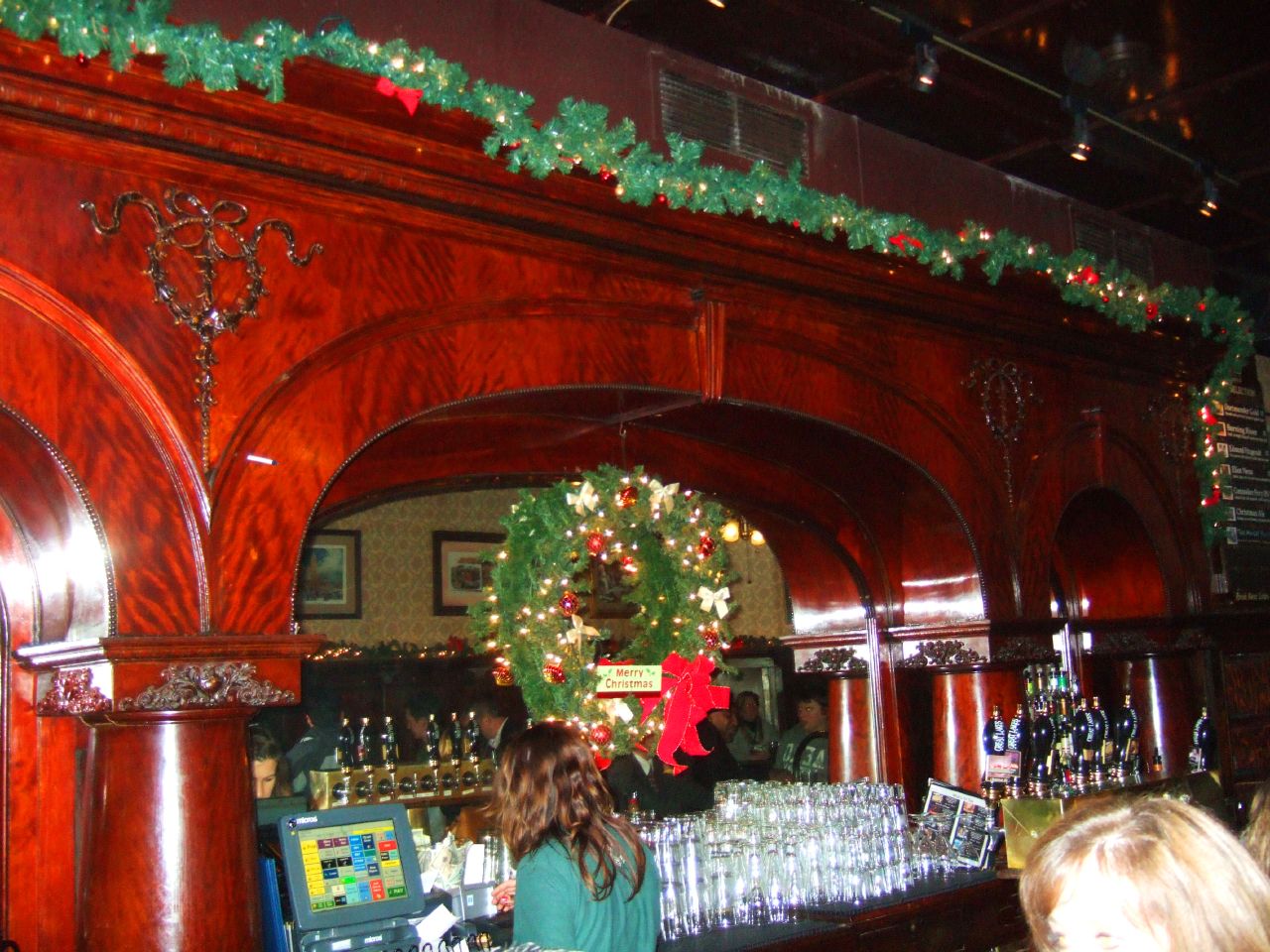
"Its most famous patron was Eliot Ness, the man credited with taking down Al Capone's gang. The Taproom retains much of the charm and mystique from the 1930s era in its grand Tiger Mahogany bar (Cleveland's oldest) and intriguing bullet holes said to have come from Eliot Ness himself."
The bar in the Taproom at the Great Lakes Brewery. There is a pen sticking out of a bullet hole put in the bar in the 1930s.
Ness' time in Cleveland is a fascinating one, marked by his fruitless search for a serial killer known as the Torso Murderer that stalked the city streets. The killer would dismember his victims and leave their remains on the banks of the Cuyahoga. The case was never solved.
We cabbed it again, heading for the lake front and the Harbor Inn, Cleveland's oldest continually operating bar, est. 1895. We were apprehensive about this joint, having heard it was both a dive and a college bar. But upon arrival, it was exactly the kind of place I'm comfortable in: a little worse for the wear, but roomy and convivial. We had a great time playing on the vintage bowling machine and downing $2 PBR tall boys.
Last, we crossed the river and entered the Flat Iron Cafe. Established in 1910, it's Cleveland's oldest Irish Bar:
"The building, which was formally a four story hotel, had a fire in the late 1800's in which the top two floors were destroyed...The first floor was used as a blacksmith's shop and the rooms on the second floor were used as lodging over the years by the sailors and longshoremen working on the lakes.”
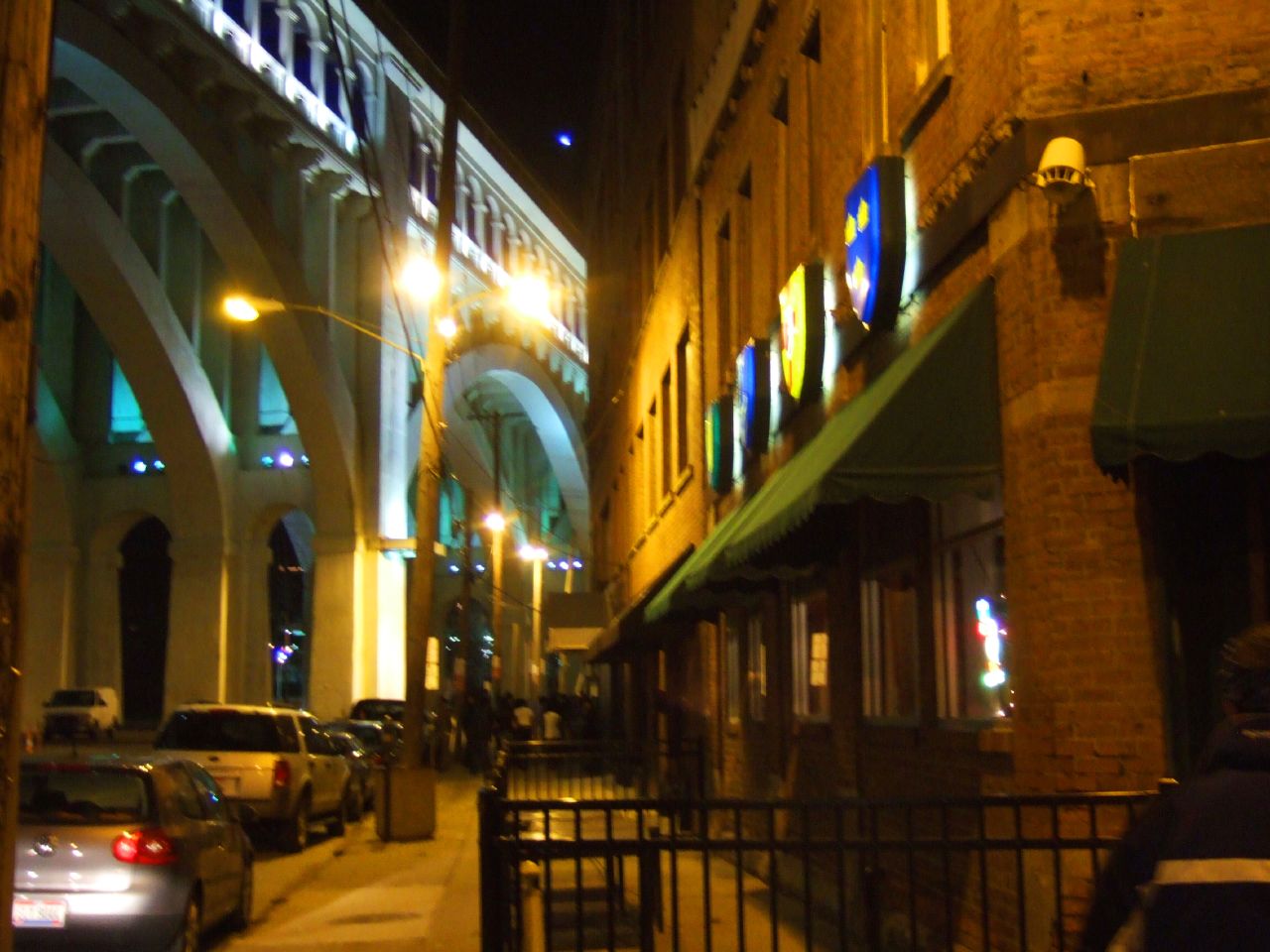
Exterior: Flat Iron Cafe
I don't remember much at this point...someone was solving a mystery. I ate a gyro from a street cart. Somebody else may have gotten married. At any rate, a good time was had by all. I'm certainly thankful for my Cleveland friends who joined me on my historic antics. And I'm thankful to have grown up in such great town with a fascinating history. I love you, Cleveland!
A post for you brewers out there: my friend Pete recently recreated a long-lost 19th century brew fermented from corn. He writes:
"Behold, beer fans. The beer pictured to the left is the Cream Common or Present Use Ale, a beer brewed with lager yeast (bottom fermenting), but at ale temperatures (55-75 degrees). This is not uncommon for a style of the 1800's -- in fact, the Steam beer, known as the California Common to non-Anchor breweries is done the same way. I believe this was done to give beer fans something to drink while waiting for their lagers, the favored beer style of the time. This beer was very popular in the midwest, and was known as a "common" due to the ordering style of the time. If you asked for an Ale, it was likely that this was what you got, unless the establishment also made their own beer. In that case, you got a "Rare Ale", which was completely different than the "Common" style of the region.
The recipe taken from here and interpreted into a much more readable recipe was a very simple brew. With 7 lbs. of base malt -- in this case, American two row malt, a very simple, clean tasting malt -- added to 3lbs of flaked maize gave a very corny scent. If you've ever smelled the water left over after making steamed corn on the cob, you've smelled how this beer smelled while mashing, and understand why I didn't want to drink something that smelled that terrible.
Thankfully, when hops were added (another American hop that would have been around at that time, Liberty, a noble hop with a very balanced smell as well as aroma. It's not too hoppy as an IPA would be, and it's not so weak as to just blend into the background.) the smell changed, considerably. The sweetness of the sugar in the corn took over, and mixed with the hops, the beer turned from boiled corn water to a delicate corn flan, with notes of cornbread in the boil.
Two weeks later, I put it in a keg and forgot about it for a week and half, to allow the beer to come up to gas, as well as give it time to mellow. Beer taken directly from the fermenter into a keg is drinkable, but, tastes green. The flavor profile never has time to develop, and as a result, the beer is a mishmash of what it's flavor is going to end up being, the notes of the chord so to speak, woefully out of tune.
Now that it's come together, the taste is wonderful. I imagine this as what the Busch, Miller and Coors families were inspired by in the Midwest. The nose is sweet, very unbeerlike with an effervescence not unlike a champagne. The taste is very earthy, and there's a piquant balance of the hop, maize and malt which swirl on the tongue in an almost sweet way. This is definitely not a savory beer, something strong and manly. At just 4.8% ABV, the beer is smooth, and quaffable, and with each sip, I almost hear a horse whinny as Sam plays something on the piano in some midwestern tavern somewhere down near Cincinnati.
This beer will very likely become my lawnmower beer -- that is to say the beer that I do some yard work and reward myself with a somewhat weak but tasty nonetheless beer that's just a bit better for me than water. It's likely that if you're at my house between May and October and ask for an Ale, you'll feel as though you've bellied up to the bar in 1863, too."
Pete adds as an addendum: "There's a book called American handy book of the brewing, malting and auxiliary trades. It's out of print, but freely available on Google books. Unfortunately, the Common vs. Rare bit is anecdotal from a brewing forum I go to. One of the gentlemen is in his seventies, and his grandfather would take him to his local tavern and order the "Common Ale", and when he had an extra dollar in his pocket, the "Rare Ale". It could be local to where he grew up (Northern Kentucky) rather than something that was done everywhere.
Here's another site, which jumpstarted the research on the recipe -- http://www.surrealstudio.net/ODanielsBlog/?cat=15 -- This could also be the difference between the Common and the Rare -- The Kentucky Common is a darker beer, and could have been brewed at different times to make it more "rare". Unfortunately, lots of the history of this stuff is lost to the aether, thanks to prohibition."
Thanks for sharing, Pete! I can't wait to quaff some the next time I'm in Cleveland.
On day two of my travels in our nation's capitol, I piled in the car with my friends Bryan and Katie, and made the drive to George Washington's home, Mt. Vernon.
It was a spectacularly beautiful fall day, and there was no where I would have rather been that driving along the Potomac with the windows down. The three of us lunched at the Mt. Vernon Inn, which offers "...six intimate dining rooms, two with fireplaces, all with colonial charm, colonial servers, and delicious regional and colonial cuisine."
I had the "Colonial Turkey Pye," (the "y" makes it old timey) which was ok, but unimpressive. I think the vegetables were from a frozen bag mix, and it had a giant Ritz cracker hat. Bryan had a cup of peanut soup,which I had tried before at the cafeteria at Gettysburg. I had liked it at Gettysburg, but here it tasted like warm peanut butter. Gross.
The main disappointment was that the menu had foods that could have been eaten in the 18th century, like roasted chicken and corncakes, but the foods weren't at all different from what we eat today. There wasn't even an effort to use spices appropriate to the 18th century. It's dull; I never understood why "historic" restaurants never make the effort to offer interesting, delicious historic food.
We spent a few hours touring the grounds, and took a fairly boring tour of the Mansion itself. The house sees a high volume of visitors each year, and the staff handles this by scooting a continuous line of tourists along a velvet-roped route through the interior of the building, while reciting the interpretation for each space on a continuous loop. You would enter the room at the beginning of the interp, and leave approximately when it would start repeating. It was weird. One fact did catch my attention: Washington died suddenly of an inflammation of the throat, that suffocated him in 36 hours. I got a little freaked out when I felt a cold coming on a few days later.
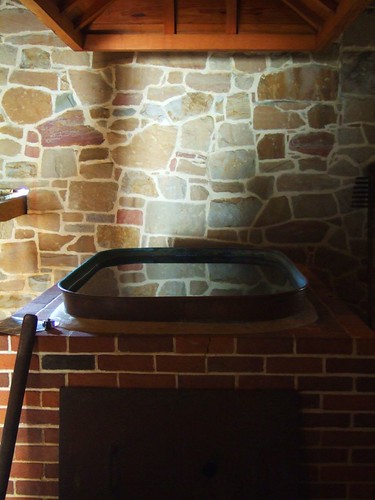
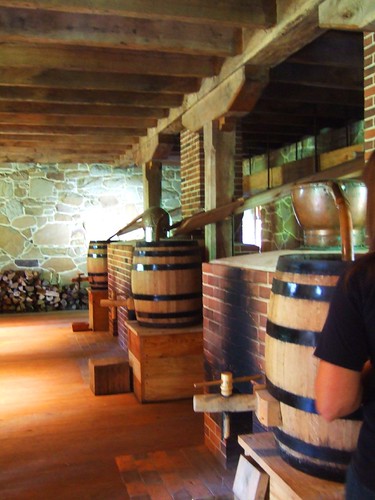
Next, we went to Mt. Vernon's second site which features a reconstruction of Washington's Gristmill and Distillery. I had been looking forward to visiting the recently opened distillery for awhile, and it really was a treat. A knowledgeable interpreter talking us through the distilling process while we toured a truly beautiful building. I learned that in the 18th century, whiskey was made from rye, with a little corn. It was not aged; the entire distilling process took only two weeks before it was casked and sold. The liquor was clear, and our guide described it as tasting surprisingly sweet. Mt. Vernon will begin selling its whiskey sometime in the next year, and I am excited to try it when they do.
The gristmill was also neat, as gristmills are. Every time I stand before a spinning water wheel, and all those gears and grindstones, I'm impressed by human ingenuity. Who thinks of these things??
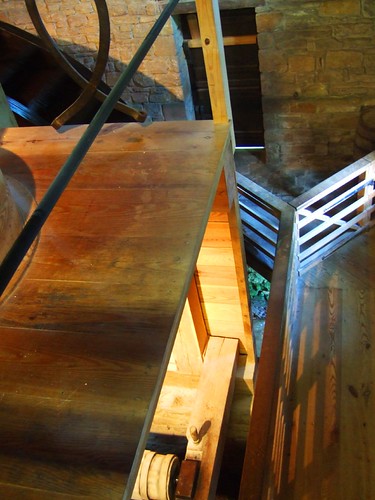
Looking down from the second floor of the gristmill, to the stream below.
I picked up a little souvenir treat for myself: a 5-ounce block of American Heritage Chocolate, a product of the Historic Division of Mars, that is made from an authentic Colonial recipe. I'm going to use it to make "Chocolet Puffs," a receipt from a 18th century manuscript that is one of the earliest instances of chocolate being used in another manner than for drinking. If the recipe turns out well, they will be sold atThe City Reliquary's 1st Annual Haveymeyer Sugar Sweets Festival on Saturday. But more on that tomorrow.
Edible Manhattan reminds us that the Bloody Mary is turning 75 on October 5th; head over to it's origin point at the St. Regis hotel to get one.
I did a video with The Feedbag at the annual, South American-style pig roast at Il Buco. The prized pigs in the spotlight? An 150 lb Ossabaw and 250 lb Crossabaw (ossabaw crossed with a modern breed). Watch the video to learn more about these breeds, and to see some serious pig fat action.
Downing the Original 1864 House Ale at Pete's Tavern. Photo by Ilana Kohn.
I am pleased to report that the 19th Century Pub Crawl was a rousing success! Over forty people turned out and we covered five bars, from E 4th st. to E 55th. A small group even made it all the way to PJ Clark's.
We were a motley crew, all ages and backgrounds, brought together by our mutual love of history. Additionally, there were some impressively costumed ladies sporting full 19th century garb, corsets and all. A couple fine gals even came straight from their jobs as historic interpreters at Old Bethpage Village. I don't think a more convivial group could be found anywhere on the streets of New York that night.
We began our crawl at Swift, a modern bar whose decor and cocktail menu are inspired by the writings of Jonathon Swift. I tried one the bar's original cocktails, the Captain Gulliver, a combination of Jameson, Ginger beer, and lemon. I had wanted to try the ginger beer, which is so 19th century, but it was non-alcoholic. This cocktail was the perfect solution.
Left: The Captain Gulliver
Next I led the group to McSorely's, who have been serving their light and dark house brew since their establishment in 1854. The light beer allegedly tastes like cream soda. I ended up not going in: McSorely's is a cornerstone of drinking at NYU, so the bar was already packed by the time we arrived at 6:30. Half of the crawl decided to stop in, and met up with us later, while the rest of us continued to our third stop, Pete's Tavern.
Pete's is also known for the house brew they have served up since 1864. It looks like a dark beer, but tastes like Miller Light. This beer marked a definite turn in my sobriety and in the sobriety of my cohorts.
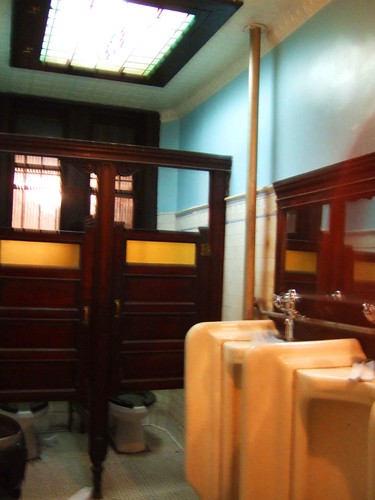
The interior was beautiful, the bartender gracious, and the staff incredibly tolerant of our drunken antics. I'd stop in Pete's any day. Next, we headed down the street to nearby Old Town Bar. At this point, we were famished, so several of us gorged ourselves on the bar's delicious burgers and fries. I also sent my friend Marc to gather reconnaissance in the men's bathroom. The marble urinals, "made by Hinsdale in 1910," are impressive enough that Old Town mentions them on their website. The tavern's dumbwaiter is also the oldest one operating in the city, and pretty cool to see in action. Right: The infamous urinals. Overall, a beautiful bathroom.
Lastly, we grabbed a cab and headed uptown to our final destination: PJ Clark's. After gorging ourselves (again) on a plate of onions rings so crispy they taste like green bean casserole, I noticed that they had an oyster bar. I was thrilled. "How Victorian!" I squealed. In every period source and novel I have read, haughty men are slurping down bivalves by the plateful.
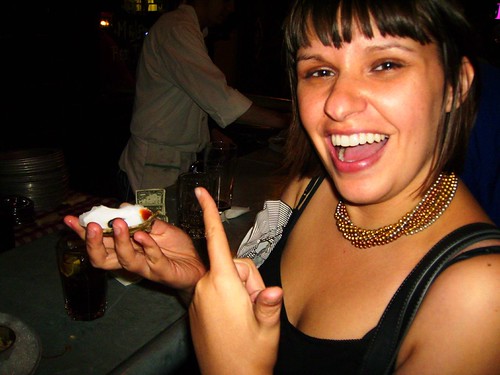
I'd never had an oyster before, so I ordered one for myself and one for Marc. To be honest, I was expecting something squishy and revolting, and misery loves company. We loaded up with condiments and sucked them down, and were surprisingly not disgusted. They just tasted like salt. Or maybe I was wasted.
The spread at PJ Clark's.
Eating my first oyster. I look enthused.
My evening ended by climbing into a cab bound for Queens. Upon arriving home, I left a trail of my clothing and personal items from my front door to my bed, where I promptly passed out. The next morning, I felt as though I had been struck by a moving carriage. If this were the 19th century, I'd be one step away from McGurk's.
To see more photos from the event, swing by our group on Flickr here. And if you're a Flickr member, and attended the event, feel free to add your own photos to our group pool.
We're already planning another crawl this spring, following the bars on Manhattan's west side that formerly served the harbor's sailors, seamen, and other rugged sorts. And is New York the only city where a woman can wear an 1860's dress with punk-red hair and not be looked at twice? We're going to find out, because we're bringing the Crawl to Boston. Stay tuned for more news.
The 19th Century Pub Crawl is TOMORROW, Saturday, September 19th at 5pm. Join us for the perfect combination of binge drinking and historic nerdery. We've gotten a lot of great listings including the New York Times, the Daily News and my personal favorite on Shecky's:
"If ye haven't yet succumbed to consumption or polio, lace on your opera boots and joine some fynefolke on this 19th Century Pub Crawl through the rapscallion-infested streets of downtown NYC. This traipsing tippling tour takes you to some of New York City's oldest bars and most notorious dens of vice. Visit www.19thcpubcrawl.com for a full itinerary and map of the route, including Swift, which is offering $1 off draughts to anyone dressed in garb of the era. $1? In the 19th century, that was like, $100!"
I want to let you in on a few things going on in my life. First, I wanted to show off my gorgeous new pinner apron, made for me by Eva of Circa 1850 and The New York Nineteenth Century Society. She hand-sewed my golden pinner using a pattern from a period source, The Workwoman's Guide, published in 1840. I am so excited to break this baby in. I love pinners. They look so smart.
Second, here's my second video with Eric at Fancyfastfood.com. We visited New York's Miss. Softee, one of the few ice cream gals in the city. You can follow here on Twitter to get updates on her current location and specials for the day: http://twitter.com/miss_softee Stop by her truck soon, she's only open until the end of September!
Ok, I have to say upfront that I was underwhelmed, and a little disappointed, by the results of my Peach Brandy experiment.
Upon my return from the 49th state, I took my mason jar filled with mashed peaches and brandy out of the fridge. Things look good, so I strained it: first through a colander, then through a double layer of cheesecloth. I began straining it through a coffee filter, but eventually lost patience, and decided what little sediment was left could remain in the brew without an adverse affect.
At this point, the brandy was surprisingly thick and syrupy, and did have a slightly sweet, slightly peachy taste. Master bartender Jerry Thomas' recipe recommends sweetening the infusion with simple syrup, but I decided against it. The cocktails I planned to mix already included a sweetener, and I've heard before (from IMBIBE! author David Wondrich) that Victorians liked their drinks very, very sweet. So I left it.
I capped my mason jar and slipped it in my purse, heading off to meet my test audience at a gathering at my boyfriend's house. I mixed two cocktails, both from Thomas' book: The Original Georgia Mint Julep, which I mixed using two parts Kentucky bourbon and one part peach brandy; and the Peach and Honey.
I had suspected the flavor of the peach brandy would come alive with a bit of sweetness, so I was really looking forward to the Peach and Honey. I dissolved the honey in a bit of water at the bottom of a rocks glass, added ice cubes, and poured the brandy over top. I tasted it--and I really wasn't thrilled. It was ok, but I felt the taste of the honey was overwhelming, not complimentary.
And tragically, the peach flavor was almost undetectable in the Julep. The brandy was served best simply over ice, where the gentle peach flavors could be fully appreciated. But even then...I'm not yet certain why the liqour was a let down for me. I think I would try this project again with bourbon instead of brandy.
I would say that there are two schools of cocktail mixing in New York right now: those who create the cocktails of tomorrow, and those who strive to recreate the imbibements of the past.
I was at an event a few days ago, where a bartender mixed a drink in which he used "Jerry Thomas' own recipe bitters." I've dug up the recipe, and I invite the more adventurous among you to give this tincture a try. Thomas suggests serving his bitters as a sort of infused rum; if you'd like to use this recipe in mixed drinks, I would recommend infusing a higher proof alcohol like Everclear. For more on the logistics of preparing bitters, refer to this excellent article.
***
"Jerry Thomas'" own Decanter Bitters
From How To Mix Drinks, by Jerry Thomas (1862)
1 Ib of raisins
2 ounces of cinnamon
1 ounce snake root*
1 lemon and 1 orange cut in slices
1 ounce of cloves
1 ounce allspice
Fill decanter with Santa Cruz rum. Bottle and serve out in pony glasses. As fast as the bitters is used fill up again with rum.
***
*The one problem with the recipe is that snakeroot is highly poisonous; in the 19th century, cows who grazed in wooded areas would eat this toxic plant, and their milk would in turn become toxic. The farmers and their families who drank it came down with "milk sickness," and were stricken with vomiting and diarrhea. The affliction claimed thousands of lives, most notable Abraham Lincoln's mother. However, I suspect the death rate was not so much result of the poisoning itself, but because the medical world was yet unaware of the importance of replacing a lost fluids. It was not uncommon for sickly babies to poop themselves to death.
Perhaps snakeroot is safer in smaller concentrations, I don't know. But please, for the sake of my conscience, don't mess around with it.
On another note, below is a video I did a few years ago at Death & Company, an East Village bar that looks to pre-prohibition era cocktails to inspire modern concoctions (their menu). They're also going to be a stop on my upcoming 19th Century Pub Crawl.
I have long dreamed of making peach brandy from scratch, a key component of my favorite summer-time drink: The Mint Julep. Too long have I made-do with "Mr. Boston." The time is right for plump, ripe peaches, so I am seizing the day and attempting to infuse my own peach brandy.
I took two large, very ripe peaches, and smushed them up good, skins and all , with the bottom of a rocks glass. I spooned them into a mason jar, and then filled the jar with brandy to the top. I mixed it around a little bit to ensure a happy marriage of brandy and peach. Thomas recommends letting the mixture macerate for 24 hours, which means in the future this mixture could be made on relatively short notice. However, I'm going to Alaska tomorrow morning for two weeks. How could letting it sit a little longer possibly hurt? It could only improve the flavor, right??
So I've just covered the jar, and pushed it to the back of the fridge. See you in two weeks, Peach Brandy! When I return, I will strain the liquid, and mix some cocktails.
I've concocted this recipe based on Jerry Thomas' "The Real Georgia Mint Julep Recipe." A winning combination of peach, mint and bourbon, the flavors blend together perfectly into a drink that's just the right amount of sweet. It is frosty, delicious, and boozey; which is really the only kind of drink I want this summer.
Place all ingredients in a blender. Fill blender with ice. Blend until smooth. If the consistency is too think, add more ice. If it is not boozy enough, add more booze. Pour in glasses and enjoy.
"BACARDI®, the world’s number-one selling rum, today announced the launch of a new multi-media advertising and marketing campaign that emphasizes the brand’s 147-year history and rum making expertise. Featuring an all-new BACARDI Mojito television spot entitled “Eras,” the campaign seeks to convey the message that the best Mojitos are made with BACARDI, the innovative rum brand first used to make this legendary cocktail."
Take a look:
Permit me to nerd out for a moment.
1. Ok, I really dig the song.
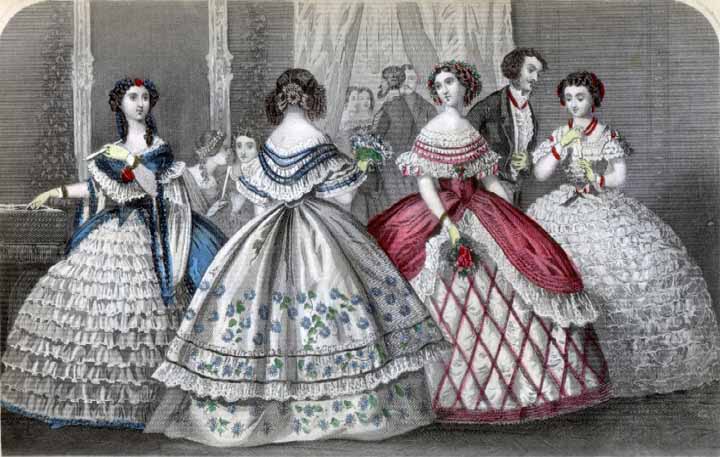
2. While they do a great job capturing the general ambiance for most decades, the costumes on the Victorian women suck. Keep in mind the Victorian era spans about 60 years. The costumes in that "era," while individually beautiful, are some sort of amalgamation of the 1820s, the 1870s and the 1890s, and definitely NOT 1862. Except for maybe the Col. Sanders looking dude. And who has ever dressed like that tart that gives him the eye at the end? (history nerds: are they doing the Virginia reel?)(update: confirmed. they are doing the Reel.)
3. "Since 1862, the best mojitos have always been made the same way." Mojitos...in 1862? When I saw this commercial for the first time during the Daily Show last night, I was hard pressed to believe mojitos had been around since 1862. Not only have I never come across a mojito recipe, they aren't similar to anything else imbibed at that time. Except, perhaps, their distant cousin, the mint julep.
I first checked with our old friend Jerry Thomas (who's book was coincidentally published in 1862.) Not a mojito to be found. I began to scour the internets.
From Wikipedia:
"Cuba is the birthplace of the mojito, although the exact origin of this classic cocktail is the subject of debate. One story traces the mojito to a similar 16th century drink, the “El Draque,” in honor of Sir Francis Drake.It was made initially with tafia/aguardiente, a primitive predecessor of rum, but as soon as Spanish rum became widely available to the British (ca. 1650) they changed it to rum. Mint, lime and sugar were also helpful in hiding the harsh taste of this spirit. While this drink was not called a mojito at this time, it was still the original combination of these ingredients.."
So while a combination of ingredients similar to the mojito existed, in the 19th c. it was being drunk by the Cuban working class. Definitely not Victorian tarts in spangly dresses.
I've also read that "The earliest "mojito" recipes...found are from 1931 and 1936 editions of a Sloppy Joe's Bar Manual." Sloppy Joe's was a famous bar in Cuba, where Hemingway apparently popularized the drink.
Bacardi was founded in Cuba, and it was known for refining what was a previously unrefined drink. Rum was a dark pungent spirit; Bacardi classed it up by running it through a charcoal filter, creating a much lighter liqour appropriate for swanky bars.
And perhaps that's what happened to the Mojito; it transformed from the rugged El Draque, to the gentile Mojito with the creation of Bacardi Rum.