Showing posts with label holidays. Show all posts

December 30, 2009

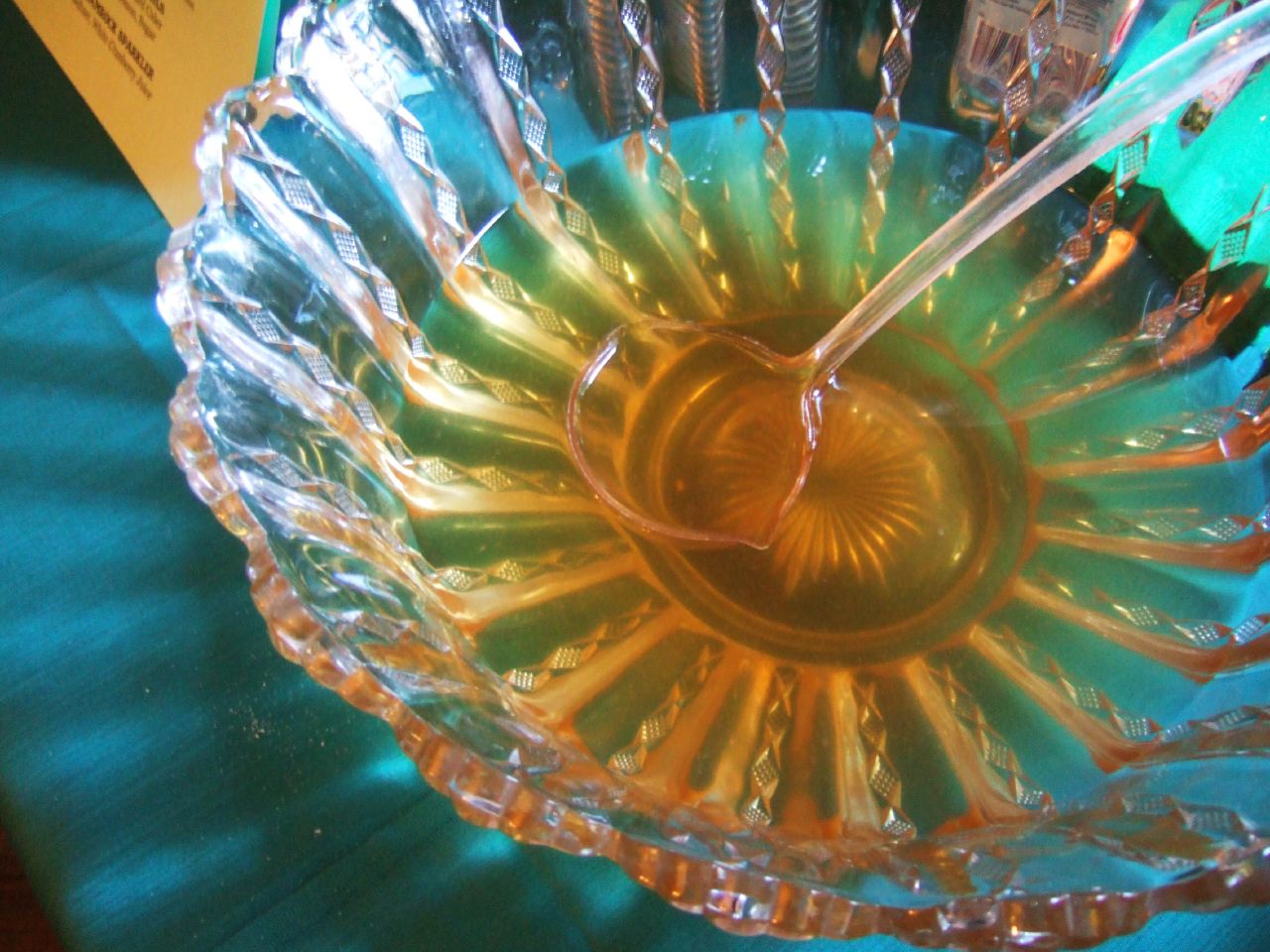
Cocktail Hour: Green Tea Punch for your New Year's Party


It tastes like the best cup of tea you've ever had.

New Year's is one of my favorite holidays, primarily because of the level of drunken debauchery it allowed in 19th century New York. According to Lights and Shadows of New York Life by James Dabney McCabe, published 1873:

""Punch is seen in all its glory on this day, and each household strives to have the best of this article. There are regular punch-makers in the city, who reap a harvest at this time. Their services are engaged long before-hand, and they are kept busy all morning going from house to house, to make this beverage, which is no-where so palatable as in this city."

During the course of the day, ladies remained at home to receive guests, and gentleman went from house to house visiting friends and, apparently, sampling the punch:

"Towards the close of the day, everything is in confusion--the door-bell is never silent. Crowds of young men, in various stages of intoxication, rush into the lighted parlors, leer at the hostess in a vain effort to offer their respects, call for liquor, drink it, and stagger out, to repeat the same scene at some other house...Strange as it may seem, it is no disgrace to get drunk on New Year's Day. The next day one half of New York has a headache..."

So in the spirit of this great day, I present to you Jerry Thomas' recipe for Green Tea Punch; a cold weather favorite that's sure to please at your New Year's Eve get together, or your New Year's Day visiting hours.

***
Tea Punch
From How to Mix Drinks by Jerry Thomas, 1862

"To make punch of any sort of perfection, the ambrosial essence of lemon must be extracted by rubbing lumps of sugar on the rind, which breaks the delicate little vessels that contain the essence, and at the same time absorb it. This, and making the mixture sweet and strong, using tea instead of water, and thoroughly amalgamating all the compounds....is the grand secret, only to be acquired by practice."

1 lemon
1/2 cup super fine sugar
1 quart boiling water
1 ounce loose leaf green tea
1 pint brandy
1 pint rum

1. Add the sugar to a large punch bowl, rub the sugar on the rind of the lemon.
2. Remove the lemon, slice in half, and juice.  Add lemon juice to the punch bowl.
3. Wrap one ounce of loose leaf green tea in cheese cloth (or other method of infusing), and brew in boiling water for at least three minutes or to taste.
3.  Add brewed tea to the punch bowl; stir until sugar is completely dissolved.
4. Add brandy and rum, stir to combine.  Serve hot.

This is the way that I make it; Thomas' recipe actually calls for a bit more flair.  Follow steps 1-3, above.  Add alcohol, then "Set these a light, and pour in the tea gradually mixing it from time to time with a ladle; it will remain burning for some time and is to be poured in that state into the glasses."  I've never attempted this method before, but perhaps this is the year.

December 28, 2009

Taste History Today: Clear Toys and Cleveland's Early Ethnic Groups


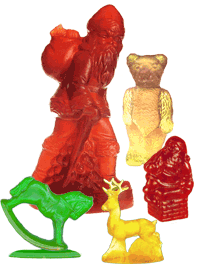
I wanted to share with you two interesting, culinary history Christmas presents I received this year. My mom tucked a pair of "clear toys" into my stocking; made by Timberlake Candies, these little treast were popular gifts in the Victorian era:

Twisted sticks of Barley Sugar were originally made in the 17th century by boiling down refined cane sugar (a new product at that time) with barley water, cream of tartar, and water. During the 18th century metal molds were used to create the wonderful variety of shapes known as Barley Sugar Clear Toys. These became a popular Victorian Christmas treat.

"Clear Toy Candy" refers to the molding of hard candy into various three dimensional shapes without sticks (not a lollypop). The term does not imply the use of Barley Candy, though traditionally Barley Sugar and Barley Candy were used to make clear toy candy.

Timberlake Candy has hundreds of antique molds appropriate for any holiday or season, but they only make the traditional barley candy for a few weeks around Christmas. Buy barley sugar candy here.

My aunt gave me a tin of spices from The Olive and The Grape , a local business in Cleveland.  The tin contains a collection of seasonings "...Reflecting the history and foods of the ten major ethnic groups who were first to settle Cleveland--African-Americans, Chinese, Czech, German, Hungarian, Irish, Italian, Polish, Slovenian and Ukrainian."  I'll have to cook a traditional Cleveland area dish appropriate to each of these ethnic groups!

December 14, 2009

History Dish Mondays: The Original Christmas Cookie


There are two very interesting aspects to this recipe.  It comes from Amelia Simmons' book 
American Cookery, the first cookbook of American authorship, published in 1796.  It's one of the earliest printed uses of the word cookie or "cookey," an Americanism derived from the Dutch word koekjea little cake that was offered as a treat to New Year's day visitors in New York City.

Secondly, this recipe was published at a time when Christmas was not uniformly celebrated.  Santa Claus wasn't invented for another thirty years, and the domestic, gift giving Christmas we're familiar with today did not exist.  There was a great debate as to whether Christmas should be celebrating piously, in quiet prayer and devotion; or in a more traditional Solstice celebration, with a focus on drinking and mischief.  "
The Antics" were roaming the streets of Boston, a rowdy gang who burst into the houses of the wealthy, and acted out bawdy plays for a reward of money or alcohol.  "Callathumpian bands" paraded around the streets of New York, their purpose to make as much noise and cause as much chaos as possible.

For more on the origins of modern Christmas, read Stephen 
Nissenbaum's amazing book, The Battle for Christmas.  I don't know more about this recipe in particular, but I was intrigued to taste the earliest American Christmas cookie recipe that I know of.

This recipe is essentially a sugar cookie flavored with coriander, which is the dried seeds of cilantro (and technically, cilantro is fresh coriander).  
Simmons'  receipt is vague, so I searched for a modern recipe I could retronovate, and found the perfect solution in Martha Stewart's Old Fashioned Sugar Cookie.  This recipe appealed to me because it uses an interesting modern technique of applying a double layer of sanding sugar, which gives the cookie a sweet glaze.  I altered the batter so it would be closer to Simmons' original recipe.  For a slightly more authentic Christmas Cookey, I recommend using a recipe for Springerle cookies, a traditional Dutch treat, and replace the anise flavor with 1-2 tsp. of ground coriander.


***
Christmas Cookeys
From American Cookery by Amelia Simmons (1796)
Modern recipe derived fromMartha Stewart's Cookies

3 cups all-purpose flour

1 teaspoon baking soda
1/4 teaspoon salt
2 tsp ground coriander
1 1/2 cups granulated sugar
1/2 cup packed light-brown sugar
1 cup unsalted butter, (2 sticks), softened
2 large eggs
Sanding sugar, for sprinkling


1. Preheat oven to 350 degrees. Whisk flour, baking soda, coriander and salt into a bowl; set aside.

2. Using an electric mixer, beat sugars and butter at a medium speed until pale and fluffy. Add eggs, one at a time, until mixed. Scrape down bowl with a rubber spatula

3. Reduce mixer speed to low and gradually add flour mixture. Mix until just combined.

4. Scoop dough into a ziploc bag or sheet of plastic wrap. Form into a ball and refrigerate for at least an hour.

5. Break off a 1/4 of the dough ball. On a generously floured surface, roll out dough until it is 1/4 inch thick. "Cut or stamp in shape and size you please (Simmons)," and place on a baking sheet. "Sprinkle tops with sanding sugar, then lightly brush with a wet pastry brush; sprinkle with more sanding sugar (Stewart)."

6. Bake for 7 minutes, turning half way through.

***
I really like these cookies; they're a simple sugar cookie, with a kick of fresh citrusy flavor form the coriander.  I've boxed them up with some Chocolet Puffs and Cayenne Gingerbread, and they'll make a lovely Christmas gift.

.

December 8, 2009

The Historic Gastonomist's Gift Guide

Curious where to find the best Christmas gifts for the culinary history enthusiast in your life?  Look no further: I've put together this list of gifts for the antiquated cook and contemporary gastronome alike..

Vintage and Historic Cook Books:

Kitchen Arts & Letters
1435 Lexington Ave, New York, NY 10128
(212) 876-5550
http://www.kitchenartsandletters.com/


"Nach Waxman is owner of one of the largest food bookstores in the country, Kitchen Arts & Letters, in Manhattan. From his perch behind the counter, he sees customers—famous chefs, not-famous line cooks, and civilians alike—streaming in to peruse his bountiful, unusual collection. Waxman shows us the basement, where he’s got some truly rare books. (chow.com)"


Joanna Hendricks Cookbooks

488 Grennwich Street, New York NY
tel. 212-226-5731
http://joannehendrickscookbooks.com/

"Located downtown, on Manhattan’s far west side, the tiny unique shop is filled with a variety of vintage cookbooks, menus, photographs and tableware. There isn’t a lot of foot traffic on this part of Greenwich Street and it’s easy to miss the store. Look for a small copper plaque that reads cookbooks, affixed to a very old and heavy wooden door. (findeatdrink.com)"


Cookware:


\
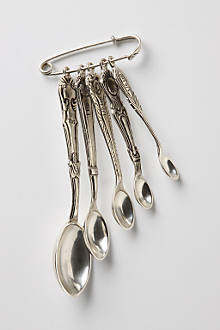
Measuring Spoons
Anthropologie.com
$24

Cast Iron Cookware from Lodge Cast Iron
http://www.lodgemfg.com/
$10 and Up

"Nestled alongside the Cumberland Plateau of the Appalachian Mountains is the town of South Pittsburg, Tennessee (population 3,300). Yet out of this tiny community comes the finest cast iron cookware in the world. Lodge Cast Iron began making cookware during the first presidential term of William McKinley. Amazingly, some of the first cast iron skillets,griddles and dutch ovens made over 100 years ago are still being put to good use."

Food:


Economy Candy
108 Rivington Street
New York, NY 10002
(800) 352-4544
order online: http://www.economycandy.com/
photo: petervh

This mega candy store on New York's lower east side carries a plethora of hard-to-find historic cooking ingredients such as preserved citron peel, dried currants, and almond paste. Additionally, they carry "Old Time Favorites," vintage candy bars like the Cherry Mash.


Deborah's Pantry
327 Sumneytown Pike
Harleysville, PA 19438
215-256-4615
order online: http://www.deborahspantry.com/

Deborah's Pantry specializes in obscure 18th century cooing ingredients and apparatus, including isinglass and pearlash.  The 18th Century Tea Sampler ($16) makes a great gift for the casual enthusiastic.

Cheese of the Month Club
$275-$775
Murray's Cheese
254 Bleecker St.
New York, NY 10014
888.MY.CHEEZ
http://www.murrayscheese.com/

The Cheese of the Month club is on everyone's wish list: "Murray's Cheese of the Month is a 1½ pound selection of 3 varied and delicious cheeses, sent to your door for 4, 6 or 12 consecutive months. Each selection includes a variety of milk types, textures and flavor profiles, with a special focus on seasonal cheeses."

December 6, 2009

Menus: St. Nicholas Society Anniversary Dinner, Dec. 6th 1851


The St. Nicholas Society of New York was founded by a man named John Pintard.  Pintard was largely responsible for the invention of our modern Christmas traditions, along with society members Washington Irving and Clement Clark Moore. These men were obsessed with the Dutch history of New York, and they appropriated St. Nick as New York City's patron saint.

I'm reading a fascinating book on Christmas traditions,  The Battle for Christmas by Stephen Nissenbaum.  It was a finalist for the Pulitzer Prize, and is a wonderful read this time of year.  Nissembaum outlines the transition of the Christmas holidays from a time of gluttony and drunkenness to a celebration of domesticity.  On the St. Nicholas Society and its members, Nissenbaum has this to say:

...It was John Pintard who brought St. Nicholas to America, in an effort to make that figure both the icon of the New York Historical Society and the patron saint of New York City....In the 1810s, Pintard organized and led elaborate St. Nicholas' Day banquets for his fellow members of the New York Historical Society...
In Holland, St. Nicholas brings toys to children on his saint's day, Dec. 6th.  Historically, this tradition was observed by upper class Dutch families.   The working class Dutch that immigrated to New Amsterdam did not bring this tradition with them.
...Nobody has ever found contemporaneous evidence of such a St. Nicholas cult in New York during the colonial period.  Instead, the familiar Santa Claus story appears to have been devised in the early nineteenth century...It was the work of a small group of antiquarian minded New York gentlemen--men who knew one another as members of a distinct social set.  Collectively, those men became known as the Knickerbockers...
In short, the Knickerbockers felt that they belonged to a patrician class whose authority was under siege.  From that angle, their invention of Santa Claus was part of what we can now see as a larger, ultimately quite serious cultural enterprise:  forging a pseudo-Dutch identity for New York, a placid "folk" identity that could provide a cultural counterweight to the commercial bustle and democratic 'misrule' of early 19th century New York.
St. Nicholas evolved into Santa Claus with the aid of Clement Clark Moore's poem A Visit from St. Nicholas.

In the above menu, note the special "Knickerbocker" recipes, various traditional Dutch dishes.  Additionally, take note of the "Ornamental Confectionery."  These would have probably been sculpted out of marzipan.


For another piece of fascinating holiday ephemera, check out Charles Dickens's original manuscript of A Christmas Carol currently housed at the Morgan Library and Museum.  The New York Times has a high-resolution scan of the full manuscript online, and "The reader who spots the most intriguing textual change will be invited to tea at the Morgan Library and Museum."

Today is also the one year anniversary of this blog.  Thank you all for your support, encouragement, and enthusiasm.  This year has been so meaningful and wonderful, and I can't wait to see what the next twelve months will bring!

December 3, 2009

Events: Emily Dickinson's Birthday Bash!


You are invited to celebrate Emily Dickinson's birthday on Thursday, December 10th, at the Bowery Poetry Club in NYC.  The event starts at 6pm, and is free!

It's a particularly special night for me because it is the premiere of Emily: Her True Self, a short film I'm working on with artist Flash Rosenberg and the Lower East Side Girls Club.

And like any good birthday party, there will be CAKE!  Emily Dickinson's "Black Cake," a fruitcake recipe found amongst the poet's papers.  I'm not baking it, but I will be there eating it.

Read more about the event here.  And if you can't make it down to the Bowery for a night of poetry and premieres, then celebrate at home with a slice of Miss Dickinson's cake.  It's a traditional fruitcake, so it's perfect for the holidays.  A recipe adapted for modern kitchens is printed below; try as I might, I couldn't track down a copy of Dickinson's original recipe online (although if anyone out there attends Harvard, you could get your hands on a copy).

Like any good fruitcake, you should let it sit in the back of your fridge for about a month before serving.  And don't forget the 179 birthday candles.

***
Emily Dickinson's Black Cake
From Emily Dickinson: Profile of the Poet as a Cook by the Guides at the Dickinson Homestead.
As reprinted on Down the Rabbit Hole

2 cups sugar
1/2 lb. butter
5 eggs
1/4 cup molasses
2 cups sifted flour
1/2 tsp baking soda
1 tsp clove
1 tsp mace
1 tsp cinnamon
1/2 tsp nutmeg, ground
1/4-1/2 cup brandy
1 lb. raisins
2/3 cup currants
2/3 lb. citron (buy citron here)
Directions:
Place a shallow pan of water on the bottom of the oven.  Preheat oven to 225 F. Add sugar gradually to butter;  blend until light and creamy.   Add unbeaten eggs and molasses.  Beat well. Re-sift flour with soda and spices. If you're using unsalted butter, add 1/2 tsp salt. Beat sifted ingredients into mixture, alternately adding brandy. Stir in raisins, currants, and citron.
Pour batter into two loaf pans lined with waxed paper. Bake at 225F for 3 hours.  Remove pan of water for last 1/2 hour. Let loaves cool before removing from pans. Remove paper and wrap in fresh paper.

November 30, 2009

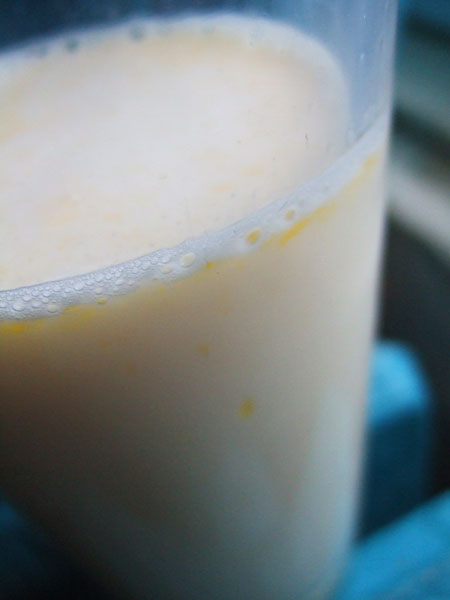
Cocktail Hour: Egg Nogg Cocktail


I've often been asked where I get the ideas for the recipes I cook.  It goes a little like this: throughout the course of my day, thought bubbles appear with a pop above my head.  They waft through the air, trailing behind me, gently enfolding images of food I would like to devour: whole roasted pigs; booze flavored jell-o; fatty dairy products.  Recently, I've been dreaming of egg nog.

My roommate whipped up a batch based on this recipe, from the NPR article "More Evidence that Egg Nog Goes Better with Booze."  It's made with raw eggs and an entire bottle of rum.  The Nog has to sit around and mellow for a month in the refrigerator.  There's a cute video about it here, where scientists test the Nog for signs of salmonella.  Preliminary tests indicate that the alcohol kills any bacteria present in the eggs.  It's hardly surprising--the nog is so boozey it tastes like creamy astringent.

The scientist's findings inspired me to test out a 19th century egg nog recipe, from Jerry Thomas' wonderful book How to Mix Drinks.  On the subject of "Egg Nogg," Thomas has this to say:
Egg Nogg is a beverage of American origin but it has a popularity that is cosmopolitan.  At the South it is almost indispensable at Christmas time and at the North it is a favorite at all seasons...Every well ordered bar has a tin egg nogg shaker which is a great aid in mixing this beverage
The Egg Nogg chapter of his book offers a variety of recipes for egg nogg as we know it, in punch form.  But the very first recipe is for what I would call an egg nogg cocktail: a single serving drink of eggs shaken up with milk and alcohol.  Perhaps this is the way egg nogg was first served, well before it filled holiday punch bowls.


***
81. Egg Nogg
From How to Mix Drinks, or the Bon-Vivant's Companion by Professor Jerry Thomas

1 tablespoon superfine sugar
1 tablespoon cold water
1 medium egg
2 ounces brandy
1 ounce rum
1/2 cup whole milk
1/4 cup shaved ice or two ice cubes

1. The first step depends on what kind of cocktail shaker you have: If you have a Boston shaker, you're going to want to put your ice in the bar glass. If you have a cobbler shaker, put the ice in the shaker. (what kind of shaker do I have?)

2. Dissolve sugar in the water in a bar glass; add egg and beat slightly. Add milk and alcohol.

3.Cover and shake (or add to cobbler shaker) until all ingredients are thoroughly amalgamated.

2. Strain into a pint glass and garnish with grated nutmeg.

***

I am drinking this right now, and I love it.  It's not as heavy as a cream-based egg nog, but it is still satisfying my nog cravings.  And the best part--it's a single serving!  So I can enjoy it anytime without having to mix up large batch.

I also suspect this recipe would be good with bourbon instead of brandy.  Either way, I highly recommend it.  It's just delicious.

If you need some training for your cocktail shake, I recommend the Hard Shake.  And if you're interested in more holiday cocktails with egg, try LeNell's Mae West Royal Diamond Fizz.

And now that I've reached the end of this post...I'm a little tipsy.  Congratulations, me.

November 26, 2009

Menus: Thanksgiving in 1845

A menu from The New England Economical Housekeeper by Esther Allen Howland.

Happy Thanksgiving, everyone! Enjoy the holiday weekend.


November 23, 2009

Events: A Revolutionary Thanksgiving Photos!


If you took any photos at the event, please add them to the Revolutionary Thanksgiving group here.

Events: Revolutionary Thanksgiving Recipe Extravaganza!


Preparing Four Pounds Flour "signature" apple tart.

The event yesterday at Old Stone House was a huge success: all the food was cooked and delicious!  We had a big turnout, thanks in part to some great press leading up to the event, including a listing on Grub Street, an article in the Village Voice and, my favorite, a wonderful feature on Brokelyn.  I'm going to be posting photos from the event photos soon!


Thanks to everyone who came out; also a big thanks to D'Artagnan for donating the wild turkey and the venison; and to Red Jacket Orchards who donated historic baking apples, the Newtown Pippin.

Many of those who attended requested my recipes, so I thought I'd share them with you here.  They are all incredibly simple and delicious, and perfect for your Thanksgiving table.

All three of these receipts were adapted from the first American cookbook, American Cookery by Amelia Simmons.  A hearth is not necessary to prepare them; you'll do just fine in a modern kitchen.

***
Stuffing for a Turkey

This recipe makes enough for one stuffed bird. If you plan to serve it as a side; bake it in a casserole at 350 degrees for 45 minutes.

1 loaf bread or cornbread
1 stick butter
1/4 lb salt pork or fat back; or 4 slices bacon.
2 eggs
1 tsp savory
1 tsp marjoram
1 handful fresh parsley, torn
10 leaves fresh sage, torn
1 tsp each Salt and pepper, or to taste.

1. Tear bread into small pieces and put in a large bowl.

2. Melt butter and pour over bread.

3. Finely chop pork and add it to the bread mixture.

4. Add remaining ingredients.  If the mixture seems too dry, add another egg.

5. Stuff into a turkey.


***
Squash Pudding

This recipe is a bit labor intensive.


2 small or one large squash. (I used 2 butternut squashes)
3 baking apples
Juice of 1/2 an orange
1/2 cup sugar
2 slices bread or 3 tablespoons unseasoned bread crumbs
1 cup cream
1 tablespoon rosewater
1/3 cup wine
3 eggs, beaten
1 tsp nutmeg
2 tsp salt
1 tablespoon flower

1. Preheat oven to 350 degrees.

2. Peel and core apples.  Slice into 1/2 in - 1 inch chunks.  Add orange juice to prevent apples from browning.  Add to a skillet with  1/4 cup sugar.  Cook on a high heat until apples bubble and steam; turn heat down to medium, and stew for 10 minutes.  Remove from heat and allow to cool.

3. Cut squash into quarters; peel and cut into one inch cubes.  Boil in a large stock pot, in lightly salted water, until tender.

4. Strain squash and add to a large mixing bowl. Mash to desired consistency with a potato masher, wine bottle, or other heavy implement.

5. Combine with remaining ingredients.

6. Bake from 45 minutes- 1 hour, until mixture is hot and bubbly around the edges.


***
Pumpkin Pie

2 cups pumpkin (canned or fresh)
2/3 cup sugar
1/3 cup real maple syrup (fresh pumpkin may need an additional 1/3 cup of maple sugar.)

1 teaspoon cinnamon
1 teaspoon mace
1 teaspoon fresh grated nutmeg
½ teaspoon salt
¼ cup milk
1 cup heavy cream
2 eggs, well beaten
¼ cup brandy

1. Preheat oven to 325.  Combine pumpkin, sugar, maple syrup, salt and spices in a mixing bowl.

2. Beat together milk, eggs, cream and brandy.  Add to pumpkin mixture.

3. Pour into an unbaked pastry shell and bake for 1 hour.

***

November 16, 2009

Origin of a Dish: Green Bean Casserole

I want to stick my face in it.

The most recent issue of Martha Stewart's Food magazine contains an abomination: a recipe for Green Bean Casserole in which all of the components are made from scratch. Shallots are hand-breaded and pan-fried. Mushrooms are seasoned and sauteed in cream. Ridiculous!

My mom and I got into a heated debate over the legitimacy of this recipe. Mom thought it might be good; I conceded that it might. However, this recipe takes a dish that was designed to be extraordinarily simple and makes it incredibly complicated!

I say don't fix what ain't broke. Green Bean Casserole was created in the 1950s during an era of canned convenience food. It has survived as a traditional Thanksgiving side dish not only because of its simplicity, but because it happens to be delicious.

From the Campbell's Kitchen webpage:

"Deemed the 'mother of comfort food,' Dorcas Reilly led the team that created the Green Bean Casserole in 1955, while working as a staff member in the Home Economics department of the Campbell Soup Company.

...She says the inspiration for the Green Bean Casserole was to create a quick and easy recipe around two things most Americans always had on hand in the 1950s: green beans and Campbell's Cream of Mushroom Soup. Like all great recipes, the casserole requires minimal number of ingredients (just five), doesn't take much time, and can be customized to fit a wide range of tastes.

In 2002, Mrs. Reilly appeared at the National Inventor's Hall of Fame to donate the original copy of the recipe to the museum. The now-yellowed 8 x 11 recipe card takes its place alongside Enrico Fermi's invention of the first controlled nuclear reactor and Thomas Alva Edison's two greatest hits: the light bulb and the phonograph."

(Editor's Note: I can find no evidence that this recipe card is actually in the Inventors Hall of Fame.)

This Thanksgiving, reenact a tiny bit of American history, and make the classic Campbell's Green Bean Casserole.


***
Classic Green Bean Casserole
from Campbell's Kitchen

1 can (10 3/4 ounces) Campbell's® Condensed Cream of Mushroom Soup (Regular or 98% Fat Free)
1/2 cup milk
1 teaspoon soy sauce
Dash ground black pepper
4 cups cooked cut green beans
1 1/3 cups French's® French Fried Onions

1. Stir the soup, milk, soy sauce, black pepper, beans and
2/3 cuponions in a 1 1/2-quart casserole.

2. Bake at 350°F. for 25 minutes or until the bean mixture is hot and bubbling. Stir the bean mixture. Sprinkle with the remaining onions.

3. Bake for 5 minutes or until the onions are golden brown.

March 19, 2009

Bridget Murphy's St. Patricks Day Celebration: Wrap Up

The event that I took part in at the Merchant's House Museum was a great success: It was well attended, and the food well received. I served Jersey Cocktails and Green Tea Punch; and also Cider Cake and a Carrot Soup that proved so popular, I will share the recipe below.

I snapped a few photos...not very many. I think there are more somewhere, and perhaps some videos on You Tube of me pontificating about mid-century booze. I'll share them as they come to light.


***

Carrot Soup
Original recipe from the manuscript of Rosa Ann Mason Grovsner, 1850s
Modern recipe adapted from The American History Cookbook, by Mark Zanger, 2003.

This is a simple, winter vegetable soup and can be made with any root vegetable.

1/2 stick salted butter
2 lbs carrots (I use bags of baby carrots; saves time and are tasty.)
1 1/2 qrts beef broth
1/4 tsp mace (this amount can be doubled or tripled for a spicier soup)
1 cup heavy cream

Melt butter in a large pot. Add carrots, mace, fresh pepper and half the stock. Cover pot and cook carrots over a low heat until tender. Push cooked carrots through a food mill, mash by hand, or use a blender. Return carrots to pot and mix with remainder of broth; taste and re-season with additional mace, salt or pepper, if desired. Bring to a boil. Reduce heat to a simmer and stir in cream.

March 3, 2009

Come See Me LIVE at the Merchant's House Museum

Don't know what to do before you get trashed on St. Patrick's day? Head on down to the Merchant's House Museum!!! From 6-8, they're hosting a special St. Patrick's day event, featuring *ME*, live and in person, and the opportunity to taste a variety of food from the 1850s. From the Official Press Release:


***

Bridget Murphy Opens her Kitchen to Celebrate St. Patrick’s Day

NEW YORK – Irish servant Bridget Murphy will open her kitchen on St Patrick’s Day for tastings of foods and drink from the 1850s -- potatoes "on the bone," and other traditional fare. You are invited to tour the servants’ quarters on the 4th floor, too, usually off limits to visitors. A bagpiper will play The Famine Song and other Celtic hits.

Food Historian and journalist Sarah Lohman of http://fourpoundsflour.blogspot.com will curate the tasting. She’ll serve potatoes "on the bone," "Bridget’s Bread Cake" (thought to be the first Irish-American recipe ever published), carrot soup, and cider cake. Featured drinks will be "Green" Tea Punch (hot rum and brandy with green tea and lemons) and Jersey Cocktails (cider – graciously provided by Original Sin Hard Cider – with bitters and lemon peel shaken over ice) from The Bon Vivant’s Companion, 1862. Other light refreshments will be served.

Tuesday, March 17, 2009, 6:00 to 8:00 p.m., $30, $15 Museum Members. Reservations Strongly Suggested; call 212-777-1089.

****

This is my first public gig as a historic gastronomist, so come out and show your support. And the Merchant's House is around the corner from McSorley's, the oldest bar in Manhattan. Abe Lincoln drank there! So finish up the night in the traditional fashion with a few pints.


The Merchant House Museum: Events

McSorely's Old Ale House

January 6, 2009

New York, New Year Cakes

My friend over at New York, Circa 1850 has made some rather pretty New York Cakes, which are traditionally served to New Year's Day callers.

Here's what she has to say about the finished product:
"The flavors (nutmeg, cinnamon, rosewater, and caraway seeds) are a bit jarring to the modern palate and the cakes are barely sweet; it has taken me a day or so to find them rather pleasant after all."

December 15, 2008

The Grand Secret of Punch


(illustration: Jerry Thomas' How to Mix Drinks)
I recently read an 1873 article on the celebration of New Year's Day in New York. Punch was a major player in the day's celebrations. So popular was the drink, that Professional Punch-Makers traveled house to house, mixing the brew:

"Punch is seen in all its glory on this day, and each household strives to have the best of this article. There are regular punch-makers in the city, who reap a harvest at this time. Their services are engaged long before-hand, and they are kept busy all morning going from house to house, to make this beverage, which is no-where so palatable as in this city."

During the course of the day, ladies staid home to receive guests, and gentleman went from house to house visiting friends and, apparently, sampling the punch:

"Towards the close of the day, everything is in confusion--the door-bell is never silent. Crowds of young men, in various stages of intoxication, rush into the lighted parlors, leer at the hostess in a vain effort to offer their respects, call for liquor, drink it, and stagger out, to repeat the same scene at some other house...Strange as it may seem, it is no disgrace to get drunk on New Year's Day. The next day one half of New York has a headache..."

Punch was so important to Victorian Americans that it occupies the first chapter of Jerry Thomas' How to Mix Drinks, the first bartending guide ever published. He offers these pieces of advice on the preparation of punch:

"To make punch of any sort of perfection, the ambrosial essence of lemon must be extracted by rubbing lumps of sugar on the rind, which breaks the delicate little vessels that contain the essence, and at the same time absorb it. This, and making the mixture sweet and strong, using tea instead of water, and thoroughly amalgamating all the compounds....is the grand secret, only to be acquired by practice."

Here are a few of Thomas' recipes; he has 86 in his book, so if you don't like these, feel free to choose some of your own. If you choose to add some punch to your New Year's celebration, please send me some photos and notes. I'm especially interested in seeing the sugar-rubbed-lemon technique and punches made with tea vs. water.

All notes in parenthesis are my own.


Hot Brandy and Rum Punch
For a party of 15.

1 quart of Jamaica Rum
1 quart Cognac Brandy
1 lb. of white loaf-sugar (regular white granulated sugar should be used here)
4 lemons
3 quarts boiling water
1 teaspoonful of nutmeg (freshly grated)

Rub the sugar over the lemons until it had absorbed all the yellow part of the skins, then put the sugar into a punch-bowl; add the ingredients well together, pour over them the boiling water, stir well together; add the rum, brandy and nutmeg; mix thoroughly, and the punch will be ready to serve.


The 69th Regement Punch

1/2 wine-glass of Irish whiskey (1/2 wine glass = 2 oz.)
1/2 wine-glass Scotch whiskey
1 tea-spoonful of sugar
1 piece of lemon
2 wine-glasses hot water

This is a capital punch for a cold night.


Pine-Apple Punch
For a party of ten.

4 bottles of champagne
1 pint Jamaica Rum
1 pint brandy
1 gill of Curacao (5 ounces)
Juice of 4 lemons
4 pine-apples sliced (I think pineapples would be smaller. 2-3 should do you.)
Sweeten to taste with pulverized white sugar (confectioner's sugar)

Put the pine-apple with one pound of sugar in a glass bowl, and let them stand until the sugar is well soaked in the pine-apple, then add all other ingredients, except the champagne. Let this mixture stand in ice for about an hour, then add the champagne. Place a large block of ice in the center of the bowl, and ornament it with loaf sugar, sliced orange, and other fruits of the season.


Egg Nogg
Use a large bar glass.

1 table-spoonful of fine sugar, dissolved with
1 table-spoonful cold water and
1 egg.
1 wine-glass of Cognac brandy
1/2 wine-glass Santa Cruz rum
1/3 tumblerful of milk

Fill the tumbler 1/4 full with shaved ice, shake the ingredients until they are thoroughly mixed together, and grate a little nutmeg on top. Hot Egg Nogg...is very popular in California, and is made in precisely the same manner as the cold egg nogg...except that you must use boiling water instead of ice.


Regent's Punch
For a party of twenty.

The ingredients for this renowed (sic) punch are: --
3 bottles champagne
1 bottle Hockheimer ((sic) this could be replaced with another Riesling)
1 bottle Curacoa (sic)
1 bottle Cognac
1 bottle Jamaica Rum
2 bottles Madeira
2 bottles Seltzer
4 lbs bloom raisins (I have no idea what a "bloom" raisin is compared to a regular raisin)

To which add oranges, lemons, rock candy, and instead of water, green tea to taste. Refrigerate with all the icy power of the Arctic.

Further reading: Dip Into the Past: Rediscovering The Pleasures Of Punch (New York Times)